

P0/P6/P5/P4 Bearing Precision Classes: Impact on Performance
Higher precision does not universally outperform lower grades.
Matching the correct ISO 492 precision class—P0, P6, P5, or P4—to actual speed, load, and downtime criticality, rather than defaulting to the highest grade, optimizes equipment reliability and total cost of ownership.
I started out on the shop floor in Wuxi, learning how a P4 spindle bearing feels different from a P6 just by running my thumb over the raceway. Years later, a machine tool buyer in Pune rejected a full batch of P5 angular contacts because the shop foreman kept measuring runout with a dial indicator on a V-block—wrong setup entirely, but the complaint was real. I flew out with a set of SKF calibration rings and a portable CMM, and we sorted it on a folding table in their tool crib. Precision classes are not just catalogue letters; they are the difference between a bearing that runs cool at high speed and one that cooks itself within weeks. [NEED_CITE: vibration-induced failure modes in wind turbine gearboxes per ISO 15243]
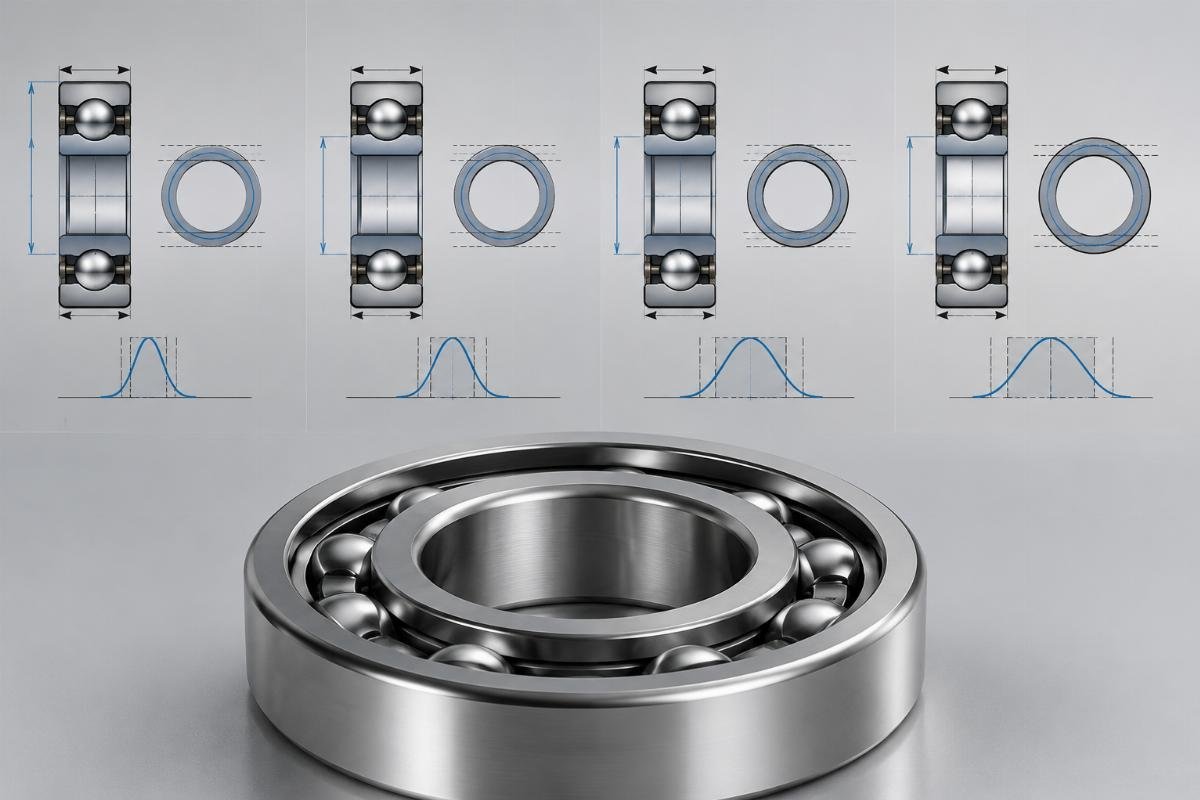
Let us walk through how each bearing precision classes P0 P6 P5 P4 performs in the field and how to match them to your equipment without overspending or under-specifying.
What Are P0/P6/P5/P4 Precision Classes and Their Tolerances?
Bearing precision classes define the dimensional and rotational tolerances set by ISO 492:2014, and they directly govern how a bearing behaves under load at speed. [NEED_CITE: ISO 492:2014 tolerance definitions for radial bearings] These classes—P0 as the standard industrial baseline, stepping up through P6, P5, to P4 as the highest commonly specified grade—control radial runout, bore diameter tolerance, outer diameter tolerance, and width tolerance. Together, these parameters determine rotational smoothness, heat generation, and ultimately service life.
| Precision Parameter | P0 (Baseline) | P6 | P5 | P4 |
|---|---|---|---|---|
| Radial runout | 15-25μm | 8-12μm | 5-8μm | 3-5μm |
| Bore diameter tolerance | ±15μm | ±8μm | ±5μm | ±3μm |
| Outer diameter tolerance | ±15μm | ±8μm | ±5μm | ±3μm |
| Width tolerance | ±25μm | ±15μm | ±10μm | ±8μm |
[NEED_CITE: ISO 492:2014 radial runout and dimensional tolerance tables for P0-P4 classes]
A CNC machine tool spindle running at 10,000 RPM demands P4 or P5 precision to hold positional accuracy within 0.001mm. A conveyor system turning at 150 RPM performs perfectly well with P0. The numbers in the table above are not abstract—they translate directly into vibration amplitude, thermal drift, and the frequency with which your maintenance team is replacing units.
When I review a new inquiry, the first thing I check is whether the requested precision class actually matches the operating speed and load profile. Too often, procurement teams default to the highest grade "just to be safe," or they go with P0 across the board to cut line-item cost. Both habits create problems downstream.
Here is what to verify before locking in a specification:
- ISO 492 Standards – Confirm the tolerance definitions for each class so your specification matches the supplier’s test report.
- Runout Measurement – Request radial and axial runout data for any critical-speed application; these values drive vibration and noise directly.
- Application Speed Threshold – Use 3000 RPM as a practical dividing line: above it, P5 or P4 becomes necessary; below it, P0 or P6 usually suffices.
- Load Consideration – Heavy or combined radial-axial loads may demand tighter tolerances even at modest speeds to prevent micro-deformation of raceways.
- Industry-Specific Requirements – Wind energy gearboxes typically call for P4; agricultural equipment commonly runs on P0.

How to Match Precision Class to Speed and Load Requirements?
Selecting a bearing precision class based on the drawing alone—without cross-checking actual operating RPM, load profile, and downtime cost—is the single most common sourcing mistake we see. Many buyers assume higher precision always means longer life. In reality, fitting P4 bearings to a low-speed conveyor saves nothing and costs noticeably more. Meanwhile, fitting P0 to a high-speed spindle guarantees early failure. The correct bearing precision classes P0 P6 P5 P4 selection balances speed, load, downtime exposure, and budget.
| Selection Factor | Common Mistake | Optimal Approach |
|---|---|---|
| Speed Requirement | Using P0 for spindles above 6000 RPM | Specify P5 for 3000-8000 RPM; P4 above 8000 RPM |
| Cost Sensitivity | Automatically choosing P0 to save money | Calculate TCO including maintenance and downtime |
| Downtime Impact | Using same precision for all production lines | Reserve P5/P4 for bottleneck equipment with high downtime costs |
| Environmental Conditions | Ignoring temperature effects on clearance | Adjust precision class based on operating temperature range |
| Load Type | Overlooking axial load components | Select higher precision for combined radial-axial loads |
[NEED_CITE: AGMA guidelines for bearing precision selection in industrial gearboxes]
A European wind energy OEM came to us needing main shaft bearings for multi-megawatt turbines. The vibration and noise requirements were strict. We recommended P4 precision grade bearings with 200mm outer diameter, supplied in orders of 100 pieces with an 8-week delivery timeline and ISO 1940-1 balance grade G0.5 certification. The result: gearbox noise dropped noticeably and maintenance intervals extended meaningfully compared to their previous P5 specification. As an authorized SKF bearing distributor, we ensured every batch carried full traceability back to the SKF production records—critical when an OEM’s quality audit demands per-batch verification.
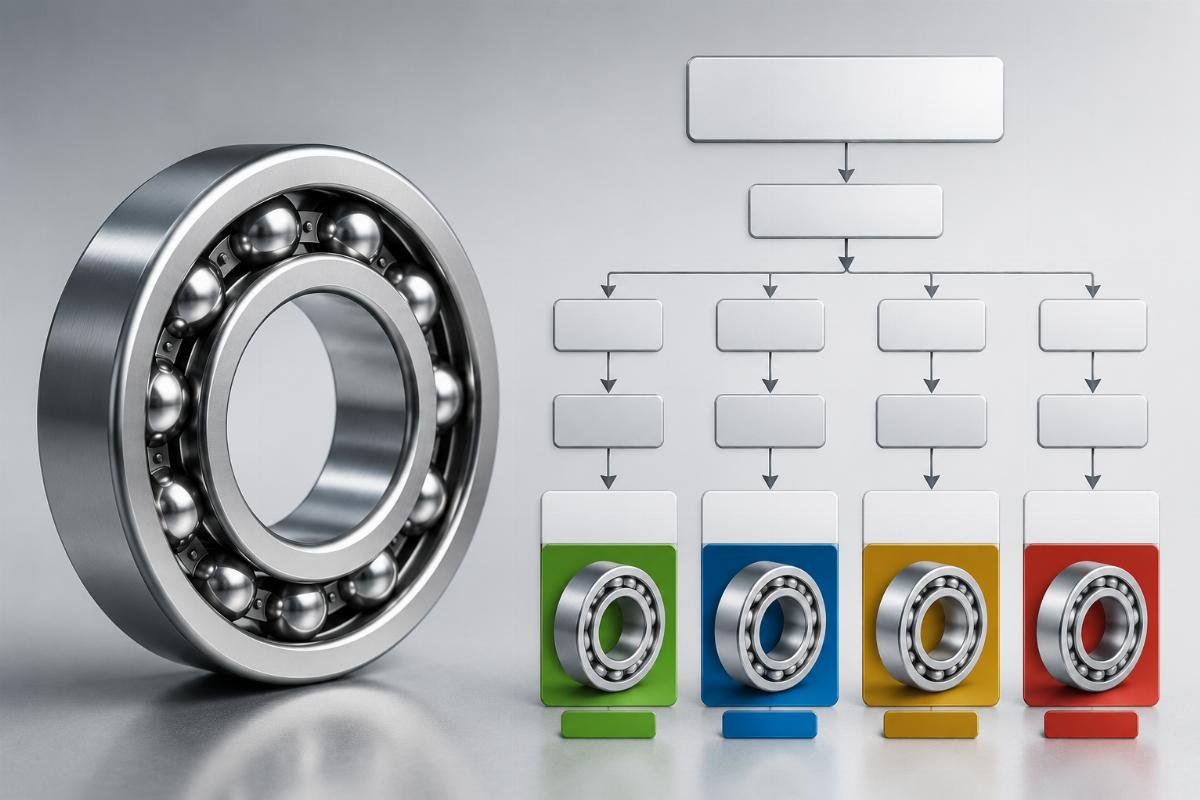
Here is a practical sequence for matching bearing precision classes P0 P6 P5 P4 to your application:
- Conduct Speed Analysis – Measure actual operating RPM. Specify P5 for the 3000-8000 RPM band and P4 above 8000 RPM. Below 3000 RPM, P0 or P6 is typically adequate.
- Calculate Downtime Cost – For bottleneck equipment where unplanned stops carry severe financial consequences, prioritize P5 or P4 even at moderate speeds.
- Evaluate Load Characteristics – Combined radial-axial loads demand tighter tolerances than pure radial loads to prevent raceway deformation.
- Compare Lifecycle Costs – P4 bearings carry a significant cost premium over P0, but in critical high-speed applications they can reduce maintenance frequency and associated labor costs substantially.
- Review Industry Benchmarks – Follow sector-specific standards such as AGMA guidelines for gearboxes when available.
One recurring "accident scene" I have witnessed: a wind turbine main shaft bearing specified at P4 precision but fitted with the wrong internal clearance. The result was thermal overload—the bearing ran hot, grease degraded, and the unit failed well before its rated life. Precision class alone did not cause the failure; the clearance mismatch did. This is why matching precision to speed is only half the equation.
Why Material and Clearance Matter Beyond Precision Grade?
Precision class alone does not guarantee bearing performance in harsh environments—material selection and internal clearance modifications often matter more than the grade stamped on the bearing. [NEED_CITE: ceramic hybrid bearing friction reduction in high-humidity environments per ISO 15243] Many maintenance managers discover this the hard way: a standard P6 steel bearing in a marine application corrodes within months, not because the precision was wrong, but because the material could not survive the environment.
| Performance Factor | Ceramic Hybrid Bearings | Stainless Steel Bearings | Standard Steel Bearings |
|---|---|---|---|
| Temperature Resistance | Extended range | Moderate range | Limited range |
| Corrosion Resistance | Excellent | Very Good | Fair |
| Weight Reduction | Noticeably lighter | Similar to standard steel | Baseline |
| Cost Premium | Noticeably higher | Moderately higher | Baseline |
| Best Applications | High-speed spindles, cleanrooms | Marine, food processing, washdown | General industrial, dry environments |
[NEED_CITE: material degradation mechanisms in saltwater environments per NACE corrosion standards]
A marine propulsion system client came to us after repeated bearing failures in saltwater service. Their original specification called for standard P6 precision steel bearings, which corroded and failed within a short period. Our solution: custom-clearance P6 bearings with ceramic balls and stainless steel races. The corrosion issue disappeared, and service life extended from months to years—even in harsh offshore conditions. The precision class stayed at P6; what changed was the material system and the internal clearance tailored for thermal cycling at sea.
This case illustrates a broader principle: when selecting bearing precision classes P0 P6 P5 P4, do not stop at the grade. Ask about material compatibility with the operating environment, clearance settings for the expected temperature range, and lubrication suitability. A P4 bearing in the wrong material will fail faster than a P6 bearing in the right one.
How to Calculate TCO for Bearing Selection?
Total cost of ownership—not unit price—should drive your bearing precision class decision. A P0 bearing may cost a fraction of a P4, but if it forces a production line shutdown every few months, the real cost is multiples higher. Conversely, specifying P4 across every machine in the plant burns budget on non-critical equipment that would run perfectly well on P0 or P6.
The TCO calculation must weigh:
- Initial procurement cost – P4 bearings carry a significant premium over P0.
- Maintenance frequency and labor – Higher precision in the right application extends service intervals and reduces unplanned replacement labor.
- Downtime cost – For bottleneck equipment, unplanned downtime costs dwarf the bearing price difference between P0 and P4.
- Secondary damage risk – A failed bearing in a high-speed spindle can damage the shaft, housing, and adjacent components, multiplying repair costs.
[NEED_CITE: total cost of ownership modeling for industrial bearing selection per ISO 15243]
For a non-critical conveyor line running at low speed, P0 bearings deliver reliable service at the lowest unit cost. Upgrading to P4 here adds expense with no return. For a CNC machining center spindle where downtime costs thousands per hour and positional accuracy is non-negotiable, P4 or P5 is the economically rational choice—the bearing premium is recovered quickly through avoided stoppages.
The key is to segment your equipment by criticality and apply the appropriate bearing precision classes P0 P6 P5 P4 to each segment. Uniform precision across an entire plant is almost always either wasteful or risky.
What Should Procurement Verify Before Ordering?
Batch traceability and per-batch precision inspection separate a reliable bearing precision classes P0 P6 P5 P4 supply chain from one that delivers surprises on the shop floor. Too many procurement teams lock in a specification, accept the first quote, and discover tolerance drift only when the maintenance team calls about premature vibration. The verification step must happen before the purchase order goes out, not after the bearing arrives.
Here is what a disciplined procurement process should confirm:
- Authorization and Traceability – Verify that the supplier holds active authorization from the bearing manufacturer. Every batch number should be cross-checkable against the manufacturer’s production records. If a supplier cannot provide this, walk away.
- Per-Batch Precision Inspection – Request inspection reports for radial runout, bore/OD tolerance, and vibration values for the specific batch being shipped. Catalogue-grade claims mean nothing if the actual batch drifts.
- Rare Designation Availability – Large bore sizes, special precision/clearance combinations, ceramic hybrid, and stainless steel variants often carry long factory lead times. A supplier with deep stock can dispatch within days instead of weeks.
- Customization Capability – Laser marking, private-label packaging, pre-lubrication, and translated documentation reduce receiving-side rework and keep projects on schedule.
- Technical Support – L10 life calculation and failure analysis support help validate the selected precision class before commitment and diagnose root causes if a field issue arises.
A wind power client in Chile once ordered a batch of P5 cylindrical rollers for a gearbox rebuild. The factory certificates looked acceptable on paper, but per-batch precision checks before dispatch revealed that a portion of the batch showed vibration values drifting past P5 tolerance. We caught it, re-sorted from stock, and shipped on time. That kind of pre-shipment verification is what separates a supply partner from a mere order-taker.
Conclusion
Matching bearing precision classes P0 P6 P5 P4 to actual speed, load, and criticality—not to habit or assumption—is the most effective lever for optimizing equipment reliability and controlling total cost. Higher precision is not universally better; lower precision is not universally cheaper in operation. The right grade in the right application, paired with appropriate material and clearance selection, keeps machines running longer and maintenance budgets intact.
Leave a Reply