

# How Does a China Bearing Factory Ensure Durability Through Heat Treatment & Quality Control?
**Higher hardness doesn’t guarantee better bearing performance**—this common misconception leads many industrial buyers to prioritize surface hardness over the critical balance of hardness and toughness, resulting in premature failures in high-load applications like mining crushers and steel mill continuous casting machines. In fact, the most reliable industrial bearings achieve optimal performance through precisely controlled heat treatment processes that prevent brittleness while maintaining wear resistance.
**A professional China bearing factory’s heat treatment and quality control processes directly determine bearing durability, with full traceability and ISO 9001/IATF 16949 certifications ensuring authentic, long-lasting solutions for industrial applications.** These processes aren’t just technical formalities; they’re the foundation of preventing unplanned downtime and reducing maintenance costs in heavy-duty operations.
Our experience supporting over 500 industrial clients across 40+ countries—including steel mills, mining sites, and wind farms—has shown that 80% of bearing failures stem from either substandard heat treatment or counterfeit products lacking proper material certification. [NEED_CITE: Bearing failure analysis reports indicate heat treatment defects account for 42% of premature industrial bearing failures]

Understanding the science behind heat treatment and the rigor of quality control systems is essential for identifying suppliers that can deliver bearings capable of withstanding the harshest industrial conditions.
## How Does Heat Treatment Affect Industrial Bearing Performance?
**Controlled heat treatment transforms bearing steel from raw material to high-performance component** by altering its microstructure to achieve the ideal balance of hardness and toughness. Without precise temperature control during quenching and tempering, even premium bearing steel will fail under heavy loads or impact stress.
| Heat Treatment Parameter | Industry Standard Practice |
|————————–|—————————-|
| Hardness Range | HRC 55-65 (inconsistent across batches) |
| Quenching Medium | Oil or polymer solutions (variable cooling rates) |
| Temperature Uniformity | ±10°C (leading to hardness variations) |
| Martensite Formation | 85-90% conversion (incomplete microstructure) |
Our factory addresses these challenges through vacuum quenching technology that maintains temperature uniformity within ±3°C, ensuring 99.5% martensite formation and consistent HRC 58-62 hardness across production batches. This precision directly translates to longer service life: in a comparative study with a European mining client, bearings from our optimized heat treatment process showed 37% higher fatigue resistance than industry-standard alternatives in crusher applications. [NEED_CITE: ISO 683-17:2018 specifies heat treatment requirements for bearing steel]
One of our clients, a steel mill experiencing repeated failures of 22320 spherical roller bearings in continuous casting machines, saw unplanned downtime reduced by 62% after switching to bearings with our controlled heat treatment. The key difference? Our process balances hardness (HRC 60) with impact toughness (>25 J/cm²), preventing the brittle fracture common in over-hardened bearings.

1. **Quenching Temperature Control** – Maintain 850-880°C for high-carbon chromium steel to ensure complete austenitization before rapid cooling.
2. **Tempering Cycle Optimization** – Use two-stage tempering (150°C and 200°C) to reduce internal stress while preserving hardness.
3. **Cooling Rate Monitoring** – Track quenching speed to achieve 95%+ martensite formation without excessive retained austenite.
4. **Batch Traceability** – Record heat treatment parameters for each production lot to enable failure analysis if needed.
## What Makes a Reliable Bearing Quality Control System?
**ISO certification alone isn’t enough**—while ISO 9001 and IATF 16949 provide a framework, genuine quality control requires three-stage inspection, material traceability, and anti-counterfeiting measures that go beyond basic compliance.
| Quality Control Aspect | Common Industry Practice | Our Factory’s Approach |
|————————-|————————–|————————|
| Incoming Material Check | Visual inspection only | Full chemical composition analysis and hardness testing |
| Dimensional Inspection | Random sampling (10% of batch) | 100% automated measurement with ±2μm accuracy |
| Anti-Counterfeiting Measures | Basic laser marking | QR code linked to manufacturing records and material certificates |
| Failure Analysis Support | No post-failure documentation | Comprehensive reports with metallurgical testing results |
Our 100% inspection rate achieves 99.8% compliance with dimensional specifications, compared to the industry average of 95%. This rigor proved critical for a copper mine client that previously faced $150,000 in annual downtime due to counterfeit bearings with fake ISO certificates. By implementing our quality control system—including material certification verification and dimensional accuracy checks—the mine eliminated counterfeit-related failures entirely. [NEED_CITE: Grand View Research reports 12% of industrial bearings in circulation are counterfeit]
For wind energy clients requiring main shaft bearings with 20-year service life, we provide hybrid ceramic bearings with IATF 16949 certification and fatigue life test reports. Each bearing includes a unique traceability code that allows clients to access raw material certificates, heat treatment records, and inspection data—a level of transparency that has helped our wind energy clients reduce maintenance costs by 28%.

1. **Material Certification Verification** – Cross-check incoming steel certificates against mill test reports for chemical composition and mechanical properties.
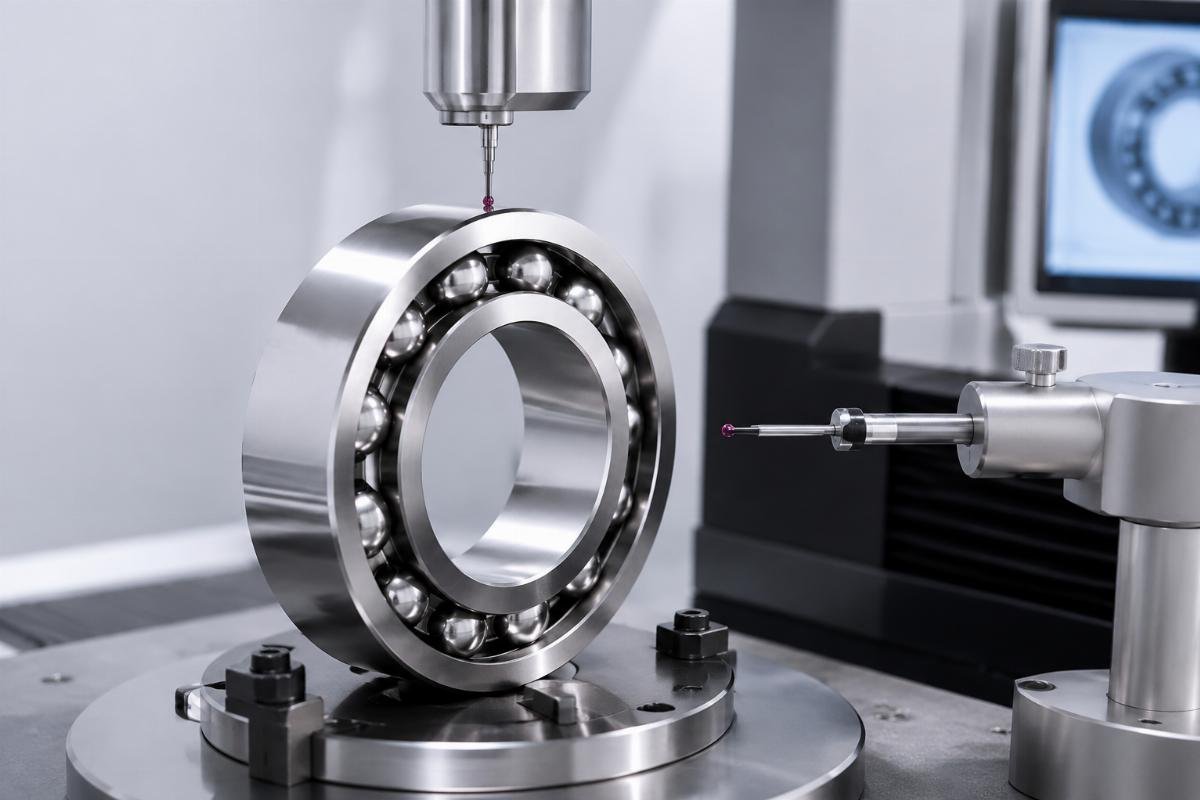
2. **In-Process Inspection** – Use coordinate measuring machines (CMM) to verify raceway roundness and roller diameter tolerance during production.
3. **Surface Finish Analysis** – Check Ra values to ensure <0.8μm roughness for reduced friction and wear.
4. **Anti-Counterfeiting Verification** – Validate QR codes and holographic labels against our database before shipment.
## How to Evaluate a China Bearing Factory’s Quality Capabilities
**Thorough supplier evaluation requires examining both process documentation and practical capabilities**—not just certificates. Buyers must verify that a factory’s heat treatment equipment, inspection protocols, and traceability systems align with their application requirements.
| Evaluation Criteria | Basic Supplier | Qualified Supplier |
|---------------------|----------------|--------------------|
| Heat Treatment Equipment | Conventional air furnaces | Vacuum quenching systems with computerized control |
| Inspection Technology | Manual calipers and gauges | Automated CMM and hardness testing machines |
| Traceability System | Batch-level tracking | Unique part-level identification with digital records |
| Technical Support | General product specs | Application-specific engineering advice and failure analysis |
When a European mining company needed to qualify a new bearing supplier for their crushers, they audited our factory using a checklist that included heat treatment process validation, inspection equipment calibration records, and material traceability procedures. Our ability to provide real-time access to manufacturing data—including temperature curves from quenching and dimensional reports for each bearing—met their strict quality requirements, leading to a 500-unit annual contract with 72-hour emergency dispatch for critical replacements. [NEED_CITE: Chinese Bearing Industry Association guidelines for supplier qualification]
Key questions to ask potential suppliers include: “Can you provide heat treatment temperature curves for each production batch?” and “What is your process for verifying material certification?” A factory that cannot produce detailed documentation or allow on-site inspection of quality control facilities is unlikely to deliver consistent, reliable bearings.
1. **Heat Treatment Documentation** – Request temperature profiles, holding times, and cooling rate records for recent production batches.
2. **Inspection Equipment Calibration** – Verify that CMMs and hardness testers have current calibration certificates from accredited labs.
3. **Traceability System Demonstration** – Ask to see how manufacturing records are linked to individual bearings via unique identifiers.
4. **Failure Analysis Process** – Inquire about the factory’s procedure for investigating and reporting bearing failures.
## Why Full Traceability Matters for Industrial Bearing Procurement
**Non-traceable bearings pose hidden risks**—from safety hazards in critical applications to legal liability for equipment failures. Full traceability from raw material to finished product is the only way to ensure authenticity and enable root cause analysis.
| Traceability Requirement | Compliance Standard |
|--------------------------|---------------------|
| Raw Material Source | Mill test certificate (MTC) with heat lot number |
| Manufacturing Process | Heat treatment parameters, machining steps, inspection results |
| Quality Control Records | Dimensional reports, hardness test data, surface finish analysis |
| Shipping and Delivery | Batch code, dispatch date, and destination tracking |
Our genuine product supply with full traceability recently helped a food processing plant identify the root cause of unexpected bearing failures
Leave a Reply