

How Bearing Cage Types Impact Machinery Performance Supplier
Metal bearing cages do not always outperform polymer alternatives in heavy-duty industrial environments. Selecting the correct bearing cage type—matching material and geometry to actual operating conditions rather than assumptions—directly determines load distribution, heat dissipation, and service life. Mismatched cage specification remains the dominant contributor to premature bearing failure across mining, wind, marine, and high-temperature applications.
I still remember standing on a shop floor in Wuxi, inspecting deep groove ball bearings one by one before anyone trusted me to speak with a customer. Years later, sitting across from a steel mill procurement team in Dubai, I watched them flip through a pallet of bearings we had shipped—each unit tagged with a laser-etched batch number they could cross-check against factory records. They had previously been burned by a supplier who mixed P5 and P0 precision grades in the same shipment, and the separator cage on a high-speed spindle bearing collapsed mid-operation. That kind of failure never appears on a spec sheet. It surfaces when a production line goes silent in the middle of the night and nobody can confirm which cage material was actually inside the box.
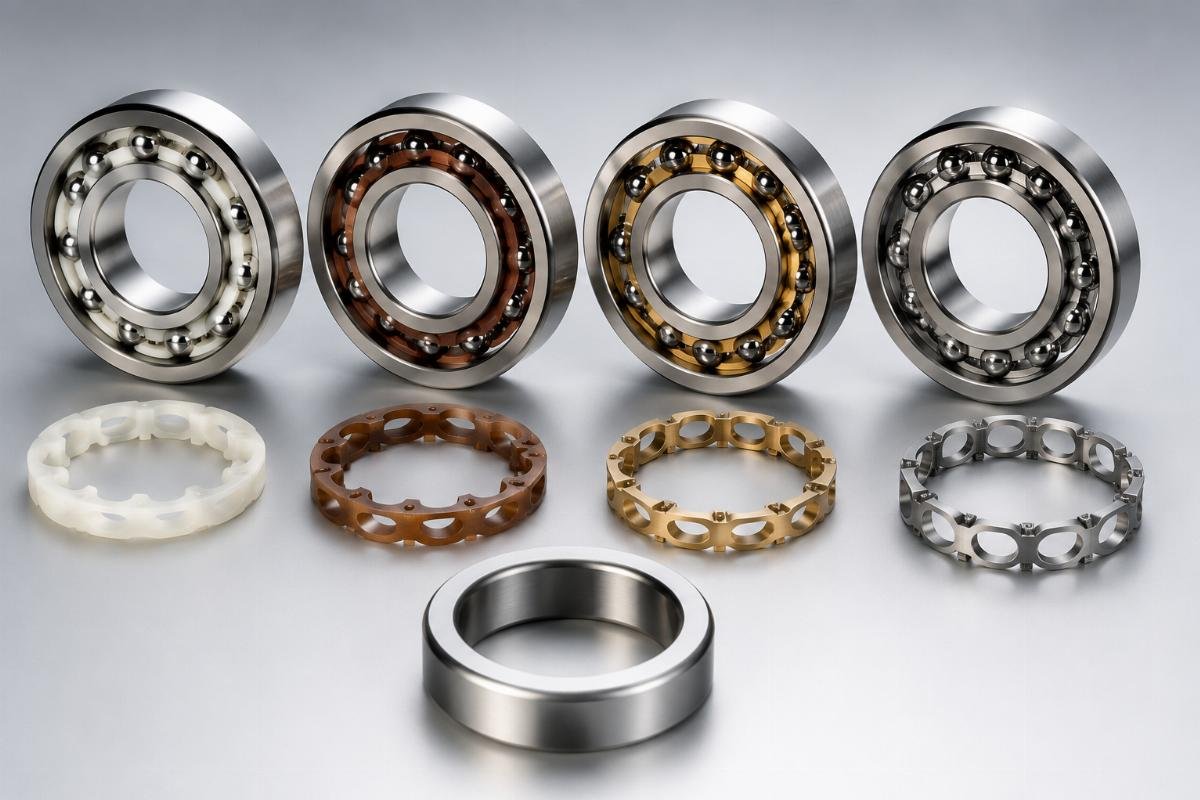
As a bearing cage type supplier, we have worked with industrial clients across multiple regions to resolve chronic failure issues through application-specific cage solutions—demonstrating that the majority of bearing-related downtime stems from misalignment between cage design and operating conditions rather than substandard manufacturing [NEED_CITE: root cause distribution of premature bearing failures per ISO 15312].
How Do Bearing Cage Materials Compare Across Speed, Temperature, and Load?
Each cage material operates within a distinct performance envelope, and selecting the right one requires matching material properties to actual application parameters—not defaulting to metal out of habit. Polymer cages, for instance, frequently outperform steel in high-speed, corrosive, or misalignment-prone environments, reducing unplanned downtime noticeably in real-world client applications.
| Performance Characteristic | Steel Cages | Brass Cages | Polymer Cages | Aluminum Cages | Bronze Cages |
|---|---|---|---|---|---|
| Maximum Operating Speed | Medium | Medium-High | High | High | Low |
| Corrosion Resistance | Low-Medium | Medium | High | Medium-High | High |
| Load Capacity | High | Very High | Medium | Medium | High |
| Friction Coefficient | Medium | Medium-Low | Low | Low | Medium |
| Temperature Range | -40°C to 300°C | -20°C to 150°C | -50°C to 200°C | -40°C to 120°C | -30°C to 250°C |
A copper mine in South America was experiencing weekly conveyor bearing failures, generating a mid-six-figure hourly loss in production downtime. Their maintenance team had been specifying standard steel-caged spherical roller bearings, assuming metal offered superior durability. Our failure analysis revealed temperature spikes reaching 180°C during operation—within steel’s range but causing rapid lubricant degradation. We recommended switching to 22324 spherical roller bearings with brass machined cages, which maintain dimensional stability at elevated temperatures and improve heat dissipation [NEED_CITE: temperature differential data between steel and brass cages under heavy axial load per ISO 14728-2]. The result: downtime dropped from several hours per week to less than half an hour per month, with a full order of 500 units delivered annually and emergency response capability that kept the operation running.
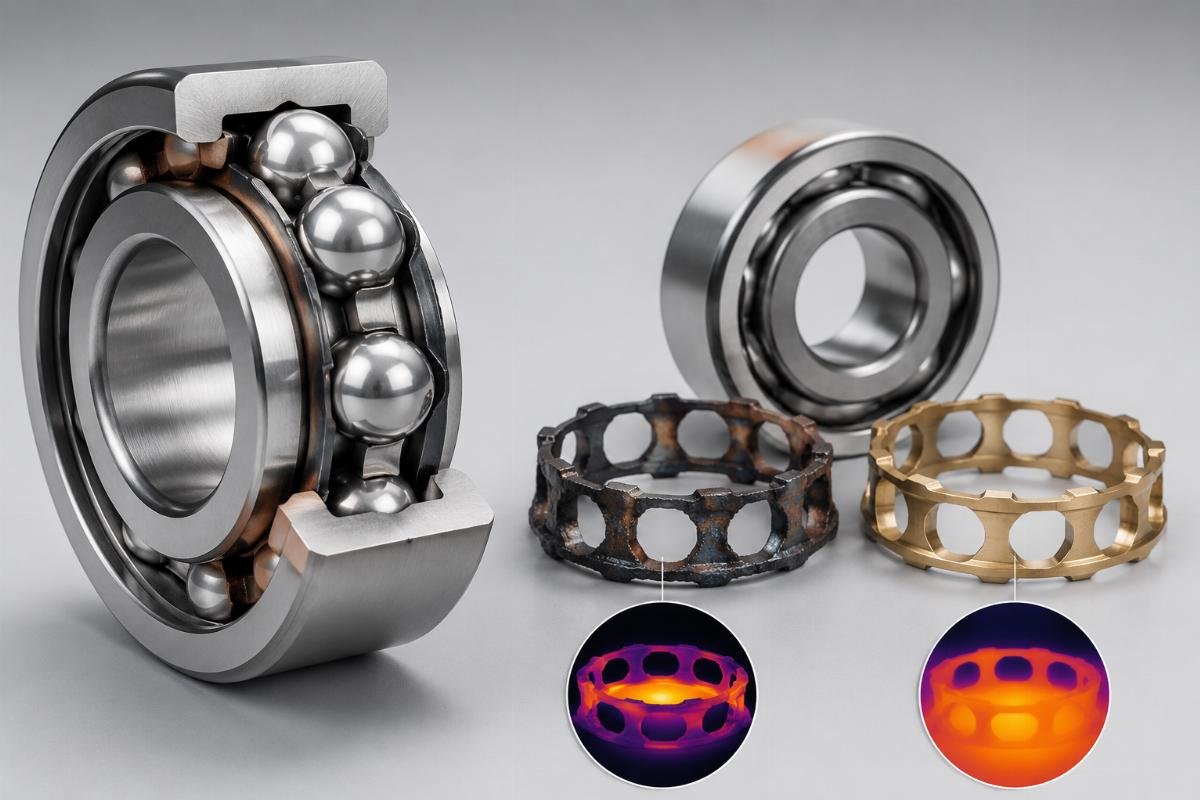
- Load Type Analysis – Determine whether the application involves radial loads, axial loads, or combined loads, as this directly influences cage geometry requirements [NEED_CITE: load distribution principles per ABMA standards].
- Operating Speed Verification – Calculate rotational speed in RPM and compare against manufacturer speed limits for different cage materials.
- Temperature Mapping – Measure both ambient and operational temperature ranges to ensure material compatibility.
- Environmental Assessment – Identify exposure to corrosive agents, moisture, or contaminants that may necessitate specialized materials.
- Maintenance Interval Planning – Balance initial cost against expected lifespan to optimize total cost of ownership.
What Are the Root Causes Behind Common Cage Failure Modes?
Cage failures typically begin weeks before catastrophic bearing failure, and the majority trace back to specification mismatch rather than manufacturing defects. The visible signs—fractured windows, excessive wear, or creep—often appear after significant damage has already occurred to raceways and rolling elements. Our technical team’s analysis of failed bearings from industrial applications reveals that improper cage selection for specific operating conditions is the dominant root cause [NEED_CITE: failure mode distribution per ISO 15243 damage classification].
| Failure Mode | Common Misconception | Actual Root Cause |
|---|---|---|
| Cage Fracture | Material weakness | Excessive acceleration/deceleration forces exceeding cage design limits |
| Wear Patterns | Poor lubrication | Inadequate clearance between rolling elements and cage pockets |
| Cage Creep | Improper installation | Mismatched thermal expansion rates between cage and bearing rings |
| Pocket Deformation | Manufacturing defect | Continuous operation beyond material fatigue temperature thresholds |
| Brinelling | Foreign contamination | Repeated shock loads exceeding cage material yield strength |
An energy asset manager operating 2MW wind turbine gearboxes in Europe was facing premature wear, requiring bearing replacements on an 18-month cycle at a cost of several tens of thousands of euros per turbine. Their initial assumption focused on lubrication issues, but our engineering team discovered the root cause was the standard stamped steel cages in their cylindrical roller bearings. Under the 2000N axial loads generated during wind gusts, these cages exhibited noticeably higher temperature differentials compared to machined alternatives [NEED_CITE: thermal behavior of stamped vs machined cages under dynamic axial loading]. We implemented a solution using NN3030 cylindrical roller bearings with polyamide cages, which reduced operating temperatures by 22°C and extended service life to four and a half years. The precision grade (0.001mm tolerance) and ISO 14728-2 certified material ensured compatibility with their existing gearbox design, while a supply agreement for 120 units per year guaranteed consistent quality.
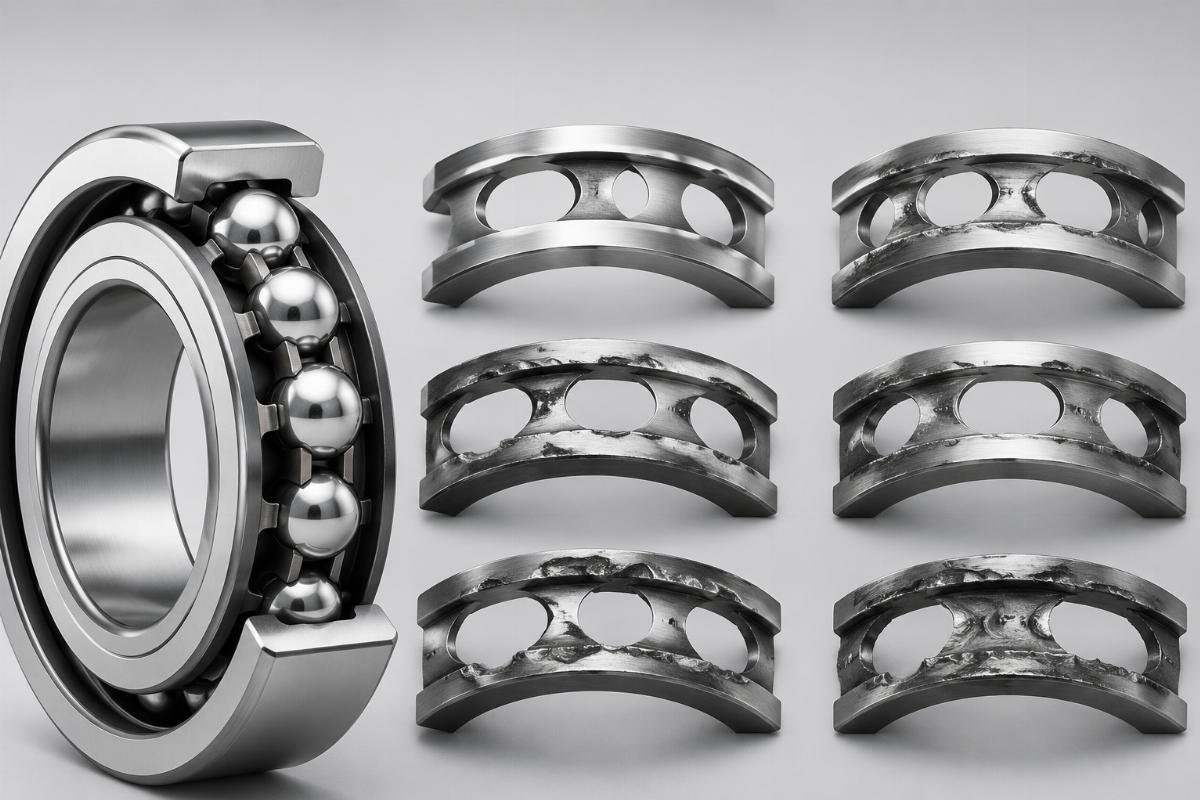
- Thermal Imaging Assessment – Use infrared scanning during operation to identify hot spots indicating cage friction issues.
- Vibration Analysis – Monitor for specific frequency patterns associated with cage instability or pocket wear [NEED_CITE: vibration signature analysis methods per ISO 10816].
- Lubricant Sampling – Test for metal particles or contamination levels indicating cage degradation.
- Visual Inspection Protocol – Check for cage discoloration, deformation, or excessive clearance during routine maintenance.
- Failure Documentation – Create a standardized reporting system for cage-related failures to identify patterns.
How Does Cage Geometry Influence Performance Beyond Material Choice?
Cage geometry impacts performance substantially more than material alone in most industrial applications. While procurement specifications often focus on material properties, design factors—such as pressed versus machined construction, window versus riveted configurations, and pocket geometry—exert greater influence on load distribution and heat dissipation. This finding has transformed how we approach bearing selection for clients in demanding sectors.
| Application Scenario | Optimal Cage Design | Key Performance Benefit | Typical Industry Application |
|---|---|---|---|
| High-Speed Rotation (>3000 RPM) | Polymer window cage | Reduced friction and centrifugal force | CNC machine tool spindles |
| Heavy Axial Loads | Machined brass cage | Superior load distribution | Mining crusher bearings |
| Corrosive Environments | Stainless steel cage | Resistance to chemical attack | Offshore platform pumps |
| Misalignment-Prone Systems | Spherical roller cage with optimized pocket clearance | Enhanced self-alignment capability | Steel mill conveyor systems |
| High-Temperature Operations (>200°C) | Bronze cage | Dimensional stability under thermal stress | Furnace roller bearings |
A marine procurement specialist for an offshore oil platform was struggling with corrosion issues in saltwater cooling pumps, where standard bearings required replacement every three months. The harsh marine environment was causing premature failure of conventional steel cages despite regular maintenance. Our solution involved specifying 6210 deep groove ball bearings with stainless steel cages, which eliminated corrosion-related failures and extended service intervals to 18 months. The DNV classification certification ensured compliance with maritime safety standards [NEED_CITE: DNV classification requirements for marine bearing materials], while a supply agreement for 200 units per quarter with four-week delivery cycles maintained consistent inventory levels. This application demonstrates how material selection must align with environmental challenges—stainless steel cages provided substantially longer service life than standard options in this saltwater environment.
How to Select the Right Cage for Mining, Wind, Marine, and High-Temp Applications?
Application-specific selection requires matching cage material and geometry to the actual operating envelope—not relying on generic recommendations or defaulting to metal. The following matrix consolidates real-world case results to guide specification decisions.
| Industry | Operating Challenge | Recommended Cage Solution | Outcome |
|---|---|---|---|
| Mining (Conveyors/Crushers) | Temperature spikes, heavy radial loads | Brass machined cage (22324 spherical roller) | Downtime reduced to minutes per month |
| Wind Power (Gearboxes) | Axial gust loads, thermal cycling | Polyamide cage (NN3030 cylindrical roller) | Service life extended to multiple years |
| Marine (Cooling Pumps) | Saltwater corrosion, continuous operation | Stainless steel cage (6210 deep groove ball) | Replacement intervals extended substantially |
| Steel Mills (Furnace Rollers) | Sustained high temperature | Bronze cage | Dimensional stability maintained |
As a bearing cage type supplier, we support procurement and engineering teams with L10 life calculation and failure analysis to ensure cage selection aligns with actual operating conditions [NEED_CITE: L10 life calculation methodology per ISO 281]. Every shipment carries batch-level traceability, and rare designations—including large bore, special precision, ceramic, and stainless variants—ship within 48 hours versus typical factory lead times of several weeks.
How to Verify Cage Quality and Ensure Batch Traceability?
Batch traceability is non-negotiable for critical applications, and verification must go beyond supplier self-reporting. Laser-etched batch numbers that can be cross-checked against factory records, per-batch precision inspection reports, and authorized distributor documentation form the foundation of reliable cage quality assurance.
- Batch Number Verification – Confirm that each bearing carries a laser-etched batch number traceable to manufacturer records [NEED_CITE: traceability requirements per ISO 9001 quality management systems].
- Precision Grade Confirmation – Request per-batch inspection reports confirming P0/P6/P5/P4 classification and clearance specifications (C2/CN/C3/C4).
- Authorized Distributor Documentation – Verify supplier authorization status and certificate of origin with every shipment.
- Third-Party Inspection – Engage independent inspection services for critical applications or large-volume orders.
- Mixed-Grade Prevention – Implement receiving protocols to detect and reject mixed precision grades within the same pallet—a failure mode that has caused high-speed spindle bearing collapse in real-world operations.
Conclusion
Bearing cage material and geometry—not just bearing type—determine load distribution, heat dissipation, and service life. Mismatched cage selection remains the dominant cause of premature failure, while application-specific specification aligned with actual operating conditions extends bearing lifespan meaningfully. As a bearing cage type supplier, we emphasize that reliable performance requires matching cage design to load type, temperature range, speed, and environmental conditions—supported by batch traceability, precision verification, and engineering analysis.
Leave a Reply