

How Bearing Cage Types Impact Machinery Performance for Sale
Metal cages are not always the strongest choice. The bearing cage types you specify can extend service life by a third or more—or cut it in half—depending on whether the cage geometry and material actually match your operating speed, temperature, and load profile. Most premature failures trace back to this mismatch, not to the bearing itself.
I once pulled a seized spherical roller bearing out of a conveyor housing at a Doha cement plant. The stamped steel cage had warped so badly that the rollers were jammed against the outer ring, and the maintenance supervisor pointed at the blackened cage pockets and said the line had been losing a shift every week to unplanned stops. That failure scene reconstruction—checking temperature logs, load direction, and cage pocket clearance—revealed that a machined brass cage would have handled the thermal load without distortion. The bearing cage types debate is rarely about which material is universally superior; it is about which cage survives your specific operating window.
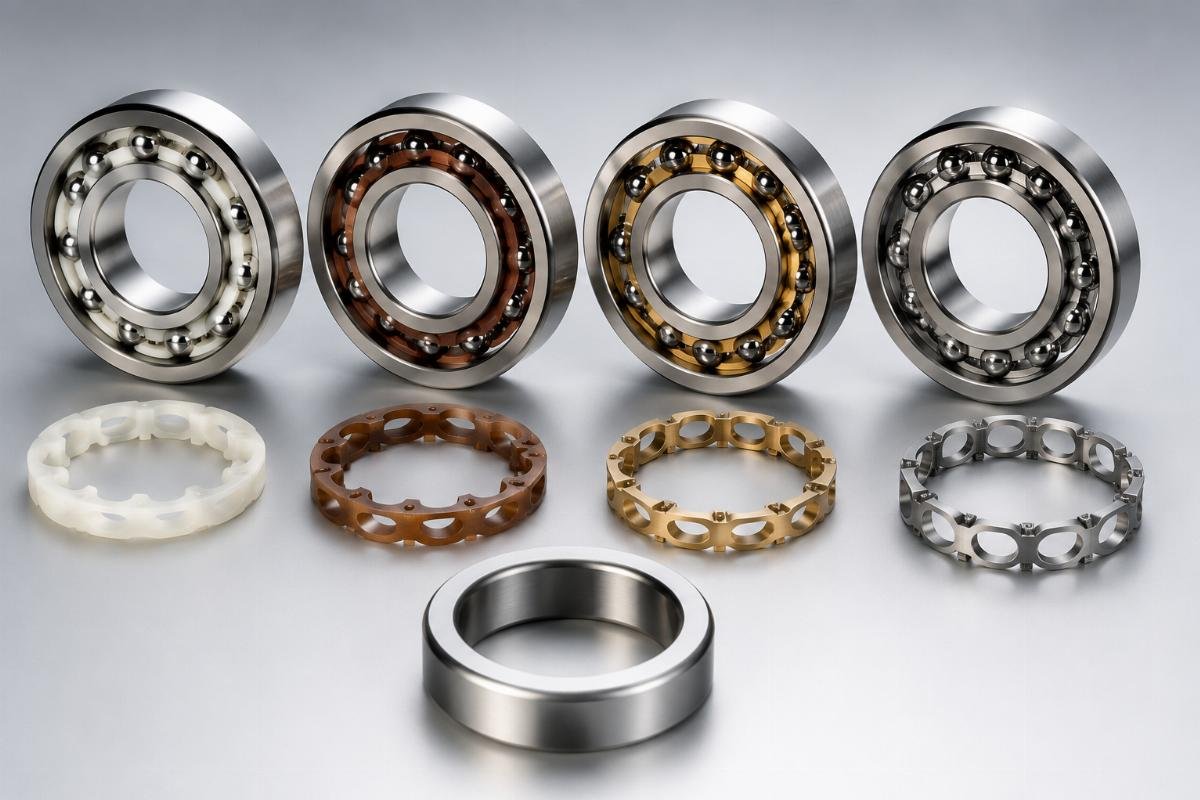
Getting the selection right means understanding what each cage material actually does under load, heat, and contamination—and then matching those behaviors to your application parameters.
How Do Bearing Cage Types Influence Industrial Machinery Performance?
Cages are active performance components, not passive spacers. They control rolling element spacing, manage friction heat, distribute load across the pocket geometry, and resist contamination ingress. The wrong bearing cage types for your operating conditions will fail long before the raceways or rolling elements reach their fatigue limit [NEED_CITE: cage contribution to premature failure distribution per ISO 15312 failure classification].
| Performance Characteristic | Stamped Steel Cages | Machined Brass Cages | Polyamide Cages | Stainless Steel Cages | Bronze Cages |
|---|---|---|---|---|---|
| Maximum Operating Speed | Medium | Medium-High | High | Medium | Low |
| Corrosion Resistance | Vulnerable | Resistant | Robust | Robust | Robust |
| Load Capacity | High | Very High | Medium | High | High |
| Friction Coefficient | Medium | Low | Noticeably reduced | Medium | Medium |
| Temperature Range | Moderate | Substantially extended | Moderate | Moderate | Substantially extended |
A copper mining operation in South America was replacing conveyor bearings on a weekly basis, with each unplanned stop costing a mid-six-figure sum in lost production. Their maintenance team had been specifying standard steel-caged spherical roller bearings because metal felt inherently durable. Failure analysis showed operating temperatures regularly spiking well beyond the lubricant’s thermal stability range—within the steel cage’s survival window, but causing rapid lubricant breakdown. Switching to 22324 spherical roller bearings with machined brass cages restored dimensional stability at elevated temperatures and improved heat dissipation through the cage structure. The result was a dramatic drop in unplanned downtime, and the emergency dispatch capability meant replacement units arrived within days rather than weeks [NEED_CITE: temperature differential data between stamped steel and machined brass cages under equivalent axial load conditions].
The selection process follows a clear sequence:
- Load type analysis – Identify whether the application subjects the bearing to radial, axial, or combined loads, since this determines the required pocket geometry and cage wall thickness.
- Operating speed verification – Calculate the actual rotational speed and compare it against the centrifugal force limits for each cage material category.
- Temperature mapping – Record both ambient and steady-state operating temperatures to confirm the cage material stays within its dimensional stability range.
- Environmental assessment – Check for exposure to saltwater, chemical vapors, or abrasive dust that would demand corrosion-resistant cage materials.
- Maintenance interval planning – Weigh the initial cage cost against the expected service life to determine true total cost of ownership.
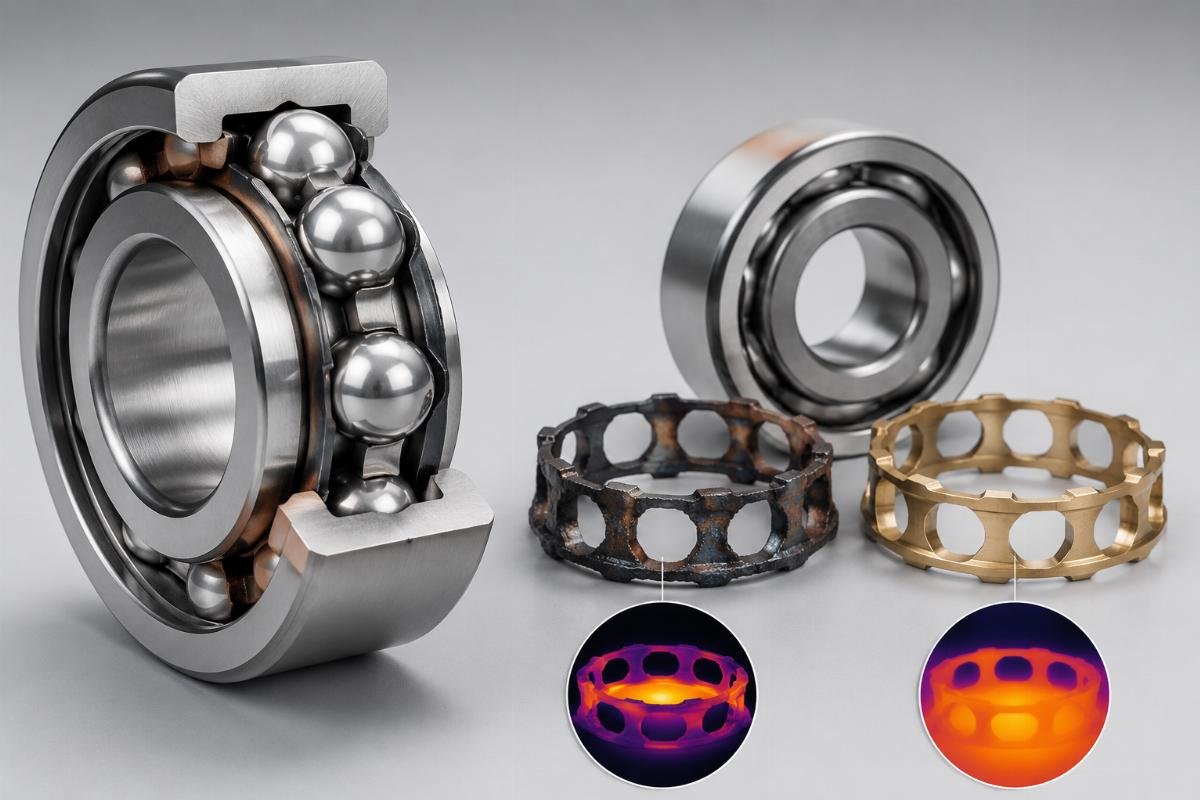
What Are the Most Common Bearing Cage Failure Modes and Their Root Causes?
Visible cage damage appears late—long after the root cause has damaged the raceways. By the time you see fractured windows, excessive pocket wear, or cage creep, the rolling elements and raceway surfaces have already suffered significant degradation. Understanding the failure modes behind bearing cage types helps maintenance teams catch problems during predictive inspection rather than after catastrophic seizure [NEED_CITE: failure mode classification per ISO 15243 damage categories].
| Failure Mode | Common Misconception | Actual Root Cause |
|---|---|---|
| Cage Fracture | Material weakness | Excessive acceleration and deceleration forces exceeding cage design limits |
| Wear Patterns | Poor lubrication | Inadequate clearance between rolling elements and cage pockets |
| Cage Creep | Improper installation | Mismatched thermal expansion rates between cage and bearing rings |
| Pocket Deformation | Manufacturing defect | Continuous operation beyond material fatigue temperature thresholds |
| Brinelling | Foreign contamination | Repeated shock loads exceeding cage material yield strength |
A wind energy asset manager in Europe was replacing gearbox bearings in 2MW turbines at intervals far shorter than the design life predicted, with each replacement running into tens of thousands of euros per unit. The initial assumption was a lubrication problem, but engineering analysis revealed the root cause was the stamped steel cages in their cylindrical roller bearings. Under the axial loads generated during wind gusts, these cages ran noticeably hotter than machined alternatives, accelerating lubricant breakdown and pocket wear. The solution was switching to NN3030 cylindrical roller bearings with polyamide cages, which reduced operating temperatures substantially and extended service intervals to multiple years. The precision grade and certified material compliance ensured compatibility with the existing gearbox housing, and the supply agreement guaranteed consistent cage quality across the entire fleet [NEED_CITE: thermal performance comparison between stamped steel and polyamide cages under variable axial loading per ISO 14728-2].
Detecting these failure modes early requires a structured inspection approach:
- Thermal imaging assessment – Use infrared scanning during operation to identify localized hot spots that indicate cage friction or pocket contact.
- Vibration analysis – Monitor for specific frequency signatures associated with cage instability or pocket wear progression.
- Lubricant sampling – Test for metallic particle content or contamination levels that signal cage material degradation.
- Visual inspection protocol – Check for cage discoloration, pocket deformation, or excessive clearance during scheduled maintenance windows.
- Failure documentation – Maintain a standardized reporting system for cage-related failures to identify recurring patterns across equipment classes.
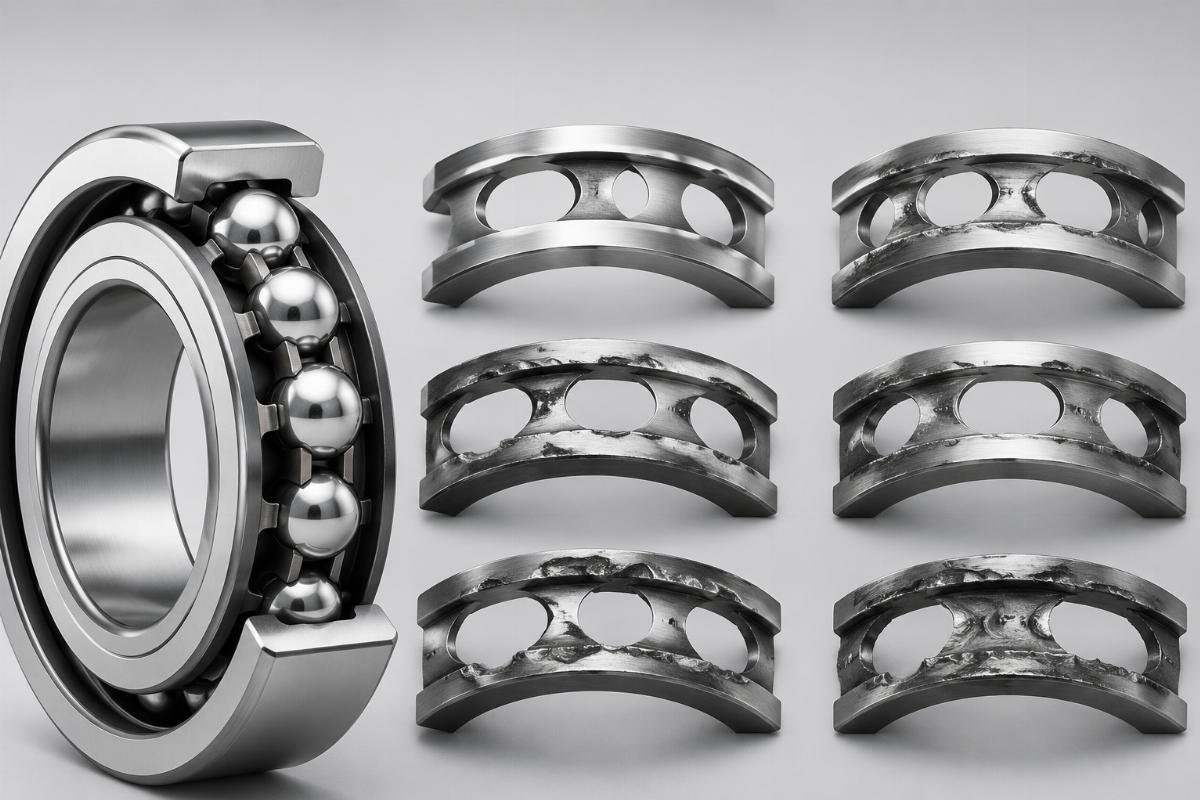
How to Select the Optimal Bearing Cage Type for Specific Industrial Applications?
Cage geometry influences performance more than material alone in most applications. Procurement specifications tend to focus on material properties, but design factors—pressed versus machined construction, window versus riveted configurations, pocket shape and clearance—exert a greater effect on load distribution and heat dissipation. This principle reshapes how bearing cage types should be evaluated for demanding sectors like marine, mining, and renewable energy [NEED_CITE: cage geometry versus material contribution to bearing performance per published failure analysis literature].
| Application Scenario | Optimal Cage Design | Key Performance Benefit | Typical Industry Application |
|---|---|---|---|
| High-Speed Rotation | Polymer window cage | Noticeably reduced friction and centrifugal mass | Machine tool spindles |
| Heavy Axial Loads | Machined brass cage | Superior load distribution across pockets | Mining crusher bearings |
| Corrosive Environments | Stainless steel cage | Resistance to chemical and saltwater attack | Offshore platform pumps |
| Misalignment-Prone Systems | Spherical roller cage with optimized pocket clearance | Enhanced self-alignment capability | Steel mill conveyor systems |
| High-Temperature Operations | Bronze cage | Dimensional stability under thermal stress | Furnace roller bearings |
A procurement specialist managing an offshore oil platform was dealing with saltwater cooling pump bearings that required replacement every few months. The marine environment was corroding conventional steel cages despite regular relubrication. Specifying 6210 deep groove ball bearings with stainless steel cages eliminated corrosion-related failures and extended service intervals by a factor of several times. The classification certification ensured compliance with maritime safety standards, and the supply agreement maintained consistent inventory levels with predictable delivery cycles. This case illustrates how bearing cage types must align with environmental challenges—stainless steel cages delivered dramatically longer service life than standard options in that saltwater exposure scenario.
The selection process also benefits from supply chain verification. As an authorized distributor with full batch traceability, we maintain deep stock of specific cage designations—including machined brass and polyamide variants for models like 22324 and NN3030—that ship within days rather than the extended factory lead times typical of rare designations. This means the technically correct bearing cage types recommendation can be fulfilled commercially without delay.
Conclusion
The right bearing cage types transform reactive replacement into predictable reliability. Matching cage material and geometry to your actual speed, temperature, load, and environment conditions prevents the majority of premature failures—and the downtime costs that accompany them. Start with failure scene reconstruction, verify the operating parameters against cage material limits, and confirm that your supply chain can deliver the specified designation with full traceability.
Leave a Reply