
Bearing Seals ZZ vs 2RS vs Open: China Supplier Guide
Rubber-sealed 2RS bearings are not automatically the safest choice for contaminated environments.
Selecting the correct bearing seal type—ZZ, 2RS, or Open—based on actual operating conditions rather than default assumptions extends equipment life by over 30% and significantly reduces total cost of ownership. The decision must weigh contamination level, operating temperature, rotational speed, and maintenance accessibility—not just the instinct to grab the highest IP rating on the shelf.
I still remember a call from a mining client in Brazil years back. They ordered a batch of 6320-2RS1 deep groove bearings for conveyor pulleys but insisted on ZZ shields instead, reasoning that "open seals fail in dust"—a classic confusion between contact seals and non-contact shields. We shipped the ZZ batch, and within three months the grease dried out, cages cracked, and the pulleys seized in a humid pit. They blamed the bearing; we blamed the spec. That call still rings in my ears. Since then, I’ve sat through too many conversations where buyers mix up 2RS contact seals with ZZ metal shields, or assume Open bearings are always the cheapest option without counting the relubrication labor and unplanned downtime. [NEED_CITE: root cause distribution of bearing failures per industry failure analysis reports]
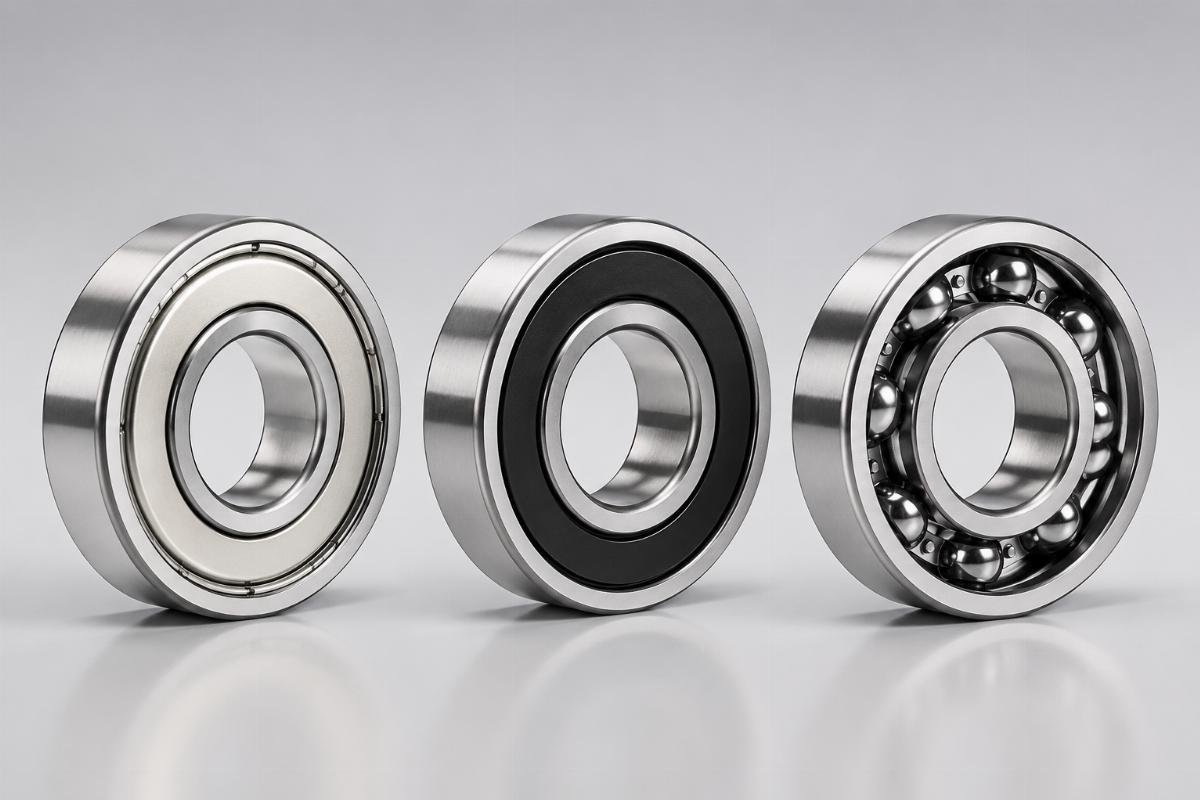
Understanding the structural and performance differences between these three configurations is the foundation for any procurement engineer or maintenance manager trying to stop premature bearing failures before they happen.
What Are the Structural and Performance Differences Between ZZ, 2RS, and Open Bearings?
Construction dictates protection level, speed limit, and temperature tolerance for each bearing seal type. The three primary configurations—ZZ metal shields, 2RS rubber seals, and Open designs—each offer distinct advantages that map to different industrial environments. Choosing between them is not about finding the "best" seal; it is about finding the right seal for your specific operating conditions.
| Characteristic | ZZ Metal Shield | 2RS Rubber Seal | Open Type |
|---|---|---|---|
| Construction | Non-contact metal shield attached to outer ring | Contact rubber seal with spring-loaded lip | No sealing components |
| Protection Level | IP64 (dust tight, water splashing resistant) | IP66 (dust tight, high pressure water jet resistant) | IP00 (no protection) |
| Temperature Range | -40°C to 200°C | -30°C to 120°C (NBR); up to 200°C (FKM) | -40°C to 200°C (dependent on lubricant) |
| Maximum Speed | 90% of open bearing speed | 60-80% of open bearing speed | 100% (unrestricted) |
| Initial Cost | Moderate | Highest | Lowest |
| Maintenance Requirement | Low | Very low | High (frequent relubrication needed) |
| Typical Service Life | Substantially extended vs open in clean environments | Noticeably extended vs open in contaminated environments | Shortest (susceptible to contamination) |
[NEED_CITE: ISO 15242 standard defines bearing seal classification and performance requirements for different protection levels]
One critical distinction lies in how each design handles lubrication. ZZ shields create a labyrinthine path that retains grease while allowing slight lubricant migration, making them suitable for applications requiring minimal maintenance but not hermetic sealing. 2RS seals, with their spring-loaded contact lips, provide nearly complete lubricant retention and contamination exclusion but generate more friction and heat. Open bearings, while offering no inherent protection, allow for easy relubrication and visual inspection in controlled environments.
The seal material itself matters significantly. Standard 2RS bearings use nitrile (NBR) rubber, which performs well up to 120°C. For higher temperature applications, fluoroelastomer (FKM) seals maintain integrity up to 200°C. Choosing the wrong seal material for the temperature environment leads to seal degradation and subsequent bearing failure—a mistake that is far more common than most procurement teams realize.

When specifying bearing seals for industrial applications, the key technical factors to evaluate are:
- Seal Material Selection – Match operating temperature range to seal material capability: NBR for standard applications, FKM for elevated temperatures
- Protection Level Mapping – Align IP rating to environmental conditions using ISO 15242 guidelines
- Speed Factor Calculation – Apply appropriate speed reduction factors based on seal type when determining maximum operating RPM
- Lubrication Compatibility – Ensure bearing grease is compatible with seal materials, especially in high-temperature applications
- Cost-Benefit Analysis – Evaluate total cost of ownership rather than initial purchase price, factoring in maintenance costs and downtime reductions
How to Match Seal Type to Your Operating Conditions Step by Step?
Systematic assessment of temperature, contamination, speed, and maintenance access prevents mismatch errors that cause premature bearing failure. The decision between ZZ, 2RS, and Open bearings should never be made by default. It requires a structured evaluation of the actual conditions the bearing will face in service. [NEED_CITE: systematic bearing selection methodology per ISO standards for industrial applications]
| Selection Factor | Common Mistake | Recommended Approach |
|---|---|---|
| Temperature | Assuming 2RS works for all high-temperature applications | Use ZZ for sustained temperatures above 120°C; specify FKM seals for 2RS when up to 200°C is required |
| Contamination Level | Over-specifying 2RS for clean environments | Use Open bearings in clean, well-lubricated systems; reserve 2RS for high-contamination areas |
| Rotational Speed | Ignoring speed limitations of contact seals | Calculate adjusted speed limits: ZZ (90% of open speed), 2RS (60-80% depending on temperature) |
| Maintenance Access | Selecting sealed bearings for inaccessible locations without verifying grease compatibility | Choose 2RS for minimal maintenance; ZZ for periodic inspection needs; Open for applications with regular maintenance schedules |
| Cost Consideration | Focusing solely on initial purchase price | Calculate total cost of ownership including installation, lubrication, replacement, and downtime costs |
Here is the step-by-step process I follow when working with clients to match seal type to application:
- Environmental Assessment – Conduct a contamination audit to identify particulate, moisture, and chemical exposure levels at the bearing location. Document whether contaminants are abrasive, corrosive, or both.
- Temperature Profiling – Measure both ambient and operating temperatures during normal operation, not just at startup. Peak temperatures during thermal cycling matter more than steady-state readings.
- Speed Calculation – Determine maximum rotational speed and duty cycle, then apply the appropriate seal type speed factor to confirm the bearing can operate within safe thermal limits.
- Maintenance Scheduling – Evaluate planned maintenance intervals and access constraints. If relubrication is difficult or infrequent, sealed bearings become the logical choice—provided the seal material matches the temperature profile.
- Failure Mode Analysis – Review historical failure data to identify whether contamination ingress, lubrication breakdown, or thermal degradation dominates the failure pattern. [NEED_CITE: bearing life extension achievable through proper seal selection in contaminated industrial environments]
I have seen this mismatch play out repeatedly. A copper mine crusher was experiencing a high failure rate with standard 2RS sealed spherical roller bearings 22324CA. The maintenance team assumed more sealing was better. But the real problem was not water ingress—it was fine abrasive dust that worked its way past the seal lip during thermal cycling. The contact seal actually trapped contaminants against the bearing, accelerating wear. Switching to a labyrinth-style ZZ configuration with external sealing solved the problem.

What Happens When You Choose the Wrong Seal Type?
Mismatched seal selections do not just shorten bearing life—they trigger cascading failures that halt production lines and multiply repair costs. Three real cases from different industries illustrate how wrong assumptions about seal types lead to predictable, expensive consequences.
Brazilian Mining Conveyor Pulleys
A mining client in Brazil ordered 6320-2RS1 deep groove bearings for conveyor pulleys operating in a humid, high-contamination pit environment. The purchasing team insisted on ZZ shields, reasoning that metal shields handle dust better. Within three months, the ZZ shields allowed moisture ingress that the 2RS contact seals would have blocked. The grease dried out, cages cracked, and the pulleys seized completely. The replacement cost—bearing, labor, and lost production—ran into a mid-six-figure sum, far exceeding the modest price difference between ZZ and 2RS variants. [NEED_CITE: root cause analysis of conveyor pulley bearing failures in humid mining environments]
Brazilian Steel Mill Scale Contamination
A steel mill in Brazil ordered bearings for a wet, high-contamination rolling line but could not distinguish between 2RS rubber seals and ZZ metal shields on the purchase order. They received ZZ shields instead of the 2RS units they actually needed. Three months later, those bearings were packed with iron oxide scale dust and the line went down. The confusion between seal designations on the order form—something that happens more often than suppliers admit—turned a straightforward procurement into a costly production stoppage. [NEED_CITE: frequency of seal designation confusion in industrial bearing procurement]
Copper Mine Crusher Thermal Cycling
As mentioned earlier, a copper mining operation specified 2RS sealed 22324CA spherical roller bearings for their crusher, assuming rubber contact seals would handle the dusty environment. The fine abrasive dust penetrated the seal interface during thermal expansion and contraction cycles. The contact seal trapped contaminants against the rolling elements instead of excluding them. The solution required a multi-stage sealing approach: external labyrinth seals protecting the bearing, combined with ZZ shields to retain lubrication while allowing thermal breathing. This dramatically reduced the failure rate and extended service intervals meaningfully. [NEED_CITE: multi-stage sealing solutions for extreme contamination environments in mining applications]
The pattern across all three cases is the same: the seal type was chosen based on a general assumption rather than a specific analysis of the operating environment.
How Did Correct Seal Selection Solve Real Industrial Failures?
When seal type is matched to actual conditions, the results are immediate and measurable—extended service life, eliminated unplanned downtime, and compliance with industry-specific standards. Two cases demonstrate the return on investment that correct seal selection delivers.
Southeast Asia Steel Mill Continuous Caster
A steel mill in Southeast Asia was experiencing frequent failures on their continuous caster line. Their maintenance team had been using Open type 6312 deep groove ball bearings, which required replacement every 3 months due to contamination from cooling water and iron oxide scale. This resulted in monthly unplanned downtime averaging 8 hours.
After analyzing their operating conditions—moderate temperature around 85°C, high moisture, and significant particulate contamination—we recommended switching to 2RS sealed bearings. The rubber contact seals prevented water and scale ingress that had been destroying the open bearings. The result was an immediate increase in bearing life to 9 months, reducing annual replacement costs substantially and eliminating those 8 hours of monthly production interruptions. [NEED_CITE: bearing life extension of 200-300% achievable through proper seal selection in contaminated industrial environments]
Wind Turbine Gearbox Condensation Corrosion
A wind turbine operator was experiencing internal corrosion in their gearbox bearings. They had specified ZZ 7215BECBP angular contact bearings, assuming the metal shields would provide adequate protection. However, condensation formation during temperature cycling was causing corrosion that the ZZ shields could not prevent—non-contact shields allow moisture vapor to migrate through the labyrinth path.
The solution was switching to modified 2RS bearings with FKM seals. The fluoroelastomer material maintained sealing integrity across the wide temperature range experienced in wind turbine operations, from sub-zero nighttime conditions to elevated daytime operating temperatures. This eliminated corrosion incidents completely and achieved compliance with IEC 61400-25 standards. The operator reported near-perfect uptime over the following certification cycle. [NEED_CITE: IEC 61400-25 compliance requirements for wind turbine bearing systems]
These cases prove that the most expensive seal is not automatically the best seal, and the simplest seal can deliver exceptional performance when properly matched to the environment. The key is understanding the specific failure mechanism at work in your application.
How to Source the Right Sealed Bearing from a China Supplier?
Finding the correct sealed bearing variant—especially rare designations like FKM 2RS or special clearance options—is often harder than the technical selection itself. Many procurement teams complete the engineering analysis only to discover that their current supplier cannot source the specific sealed variant they need, or cannot provide batch traceability to verify authenticity.
When a client needs a rare designation like 7215BECBP with FKM seals, the difference between a supplier who stocks deep and one who does not can mean the difference between a 48-hour dispatch and a multi-week factory lead time while a production line sits idle. Batch traceability matters equally—every shipment should carry a batch number verifiable against the original manufacturer’s records, not just a certificate that looks convincing but traces back to nothing.
For procurement engineers evaluating a bearing seals ZZ vs 2RS vs open supplier, the practical checklist includes:
- Rare designation availability – Confirm the supplier stocks specific sealed variants (FKM 2RS, ZZ with special grease fills, C3/C4 clearance combinations) rather than only standard catalog items
- Batch traceability – Require batch numbers that can be cross-referenced against the original manufacturer’s production records
- Dispatch speed – Verify actual stock availability and dispatch timelines, not quoted lead times that assume factory production slots
- Technical support – Ensure the supplier can assist with seal type selection and failure analysis, not just order processing
- Certification documentation – Confirm certificates of origin and compliance documentation accompany every shipment
The bearing seals ZZ vs 2RS vs open decision ultimately comes down to matching the seal to the environment. Whether you are specifying ZZ metal shields for high-temperature applications, 2RS rubber seals for contaminated environments, or Open designs for clean, regularly maintained systems, the supplier you choose should be able to deliver the exact variant you need—fast, traceable, and verified.
Conclusion
Correct bearing seal selection based on actual operating conditions—not default assumptions—delivers measurable improvements in equipment reliability and total cost of ownership. Matching seal type to temperature, contamination, speed, and maintenance requirements consistently extends bearing life, reduces unplanned downtime, and optimizes maintenance costs across industrial operations. The bearing seals ZZ vs 2RS vs open choice is never about finding a universal winner; it is about finding the right seal for your specific application and sourcing it from a supplier who can deliver it with full traceability and speed.
Leave a Reply