
Bearing Seals & Shields: ZZ vs 2RS vs Open Types – China Supplier Guide
Rubber-sealed 2RS bearings are not universally superior for harsh environments.
Matching seal type—ZZ metal shields, 2RS rubber seals, or open designs—to specific operating conditions including temperature, speed, contamination level, and maintenance access delivers measurable improvements in reliability and total cost of ownership, while improper seal selection accounts for the majority of premature bearing failures across industrial applications.
I started out on the shop floor in Wuxi, sorting bearing batches before I ever saw a purchase order. Years later, a Dubai-based mining client ordered a full set of spherical rollers for a conveyor line and specifically asked for 2RS seals—they were running in a high-dust, low-speed environment. I shipped what they asked for. Three months in, the seals were pumping grease out and pulling dust in. The 2RS lip seals could not handle the shaft deflection and heat buildup at that speed. We had to air-freight replacement C3-clearance ZZ shields from Sweden, re-lube on site, and rewrite the whole spec sheet. That is when the ZZ vs 2RS debate stopped being a textbook question for me and became a field lesson. Industry failure analysis reports consistently show that improper seal selection represents a leading root cause of premature bearing failures in industrial environments [NEED_CITE: root cause distribution of bearing failures per ISO 15243 classification].
Now I look at application conditions before I look at a price list. Let me walk you through the technical distinctions, selection methodology, and real-world outcomes that shape every bearing seals ZZ 2RS open type conversation we have with procurement teams and maintenance engineers.
What Are the Key Differences Between ZZ, 2RS, and Open Bearing Seals?
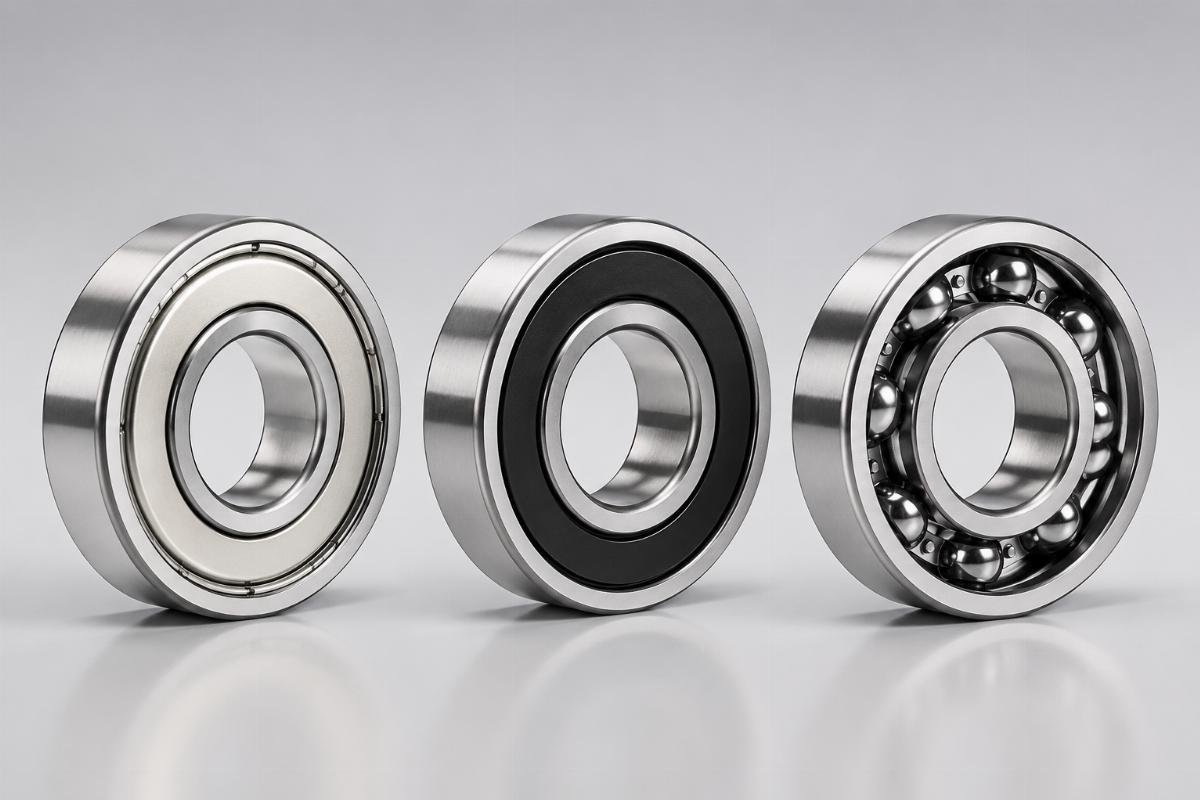
ZZ shields offer the majority of open bearing speed capability with IP64 protection; 2RS seals provide IP66 ingress protection but limit speed to a reduced range; open types allow full speed but require frequent relubrication. The three primary configurations each offer distinct advantages that make them suitable for different industrial environments, and understanding these differences is the foundation of any bearing seals ZZ 2RS open type evaluation.
| Characteristic | ZZ Metal Shield | 2RS Rubber Seal | Open Type |
|---|---|---|---|
| Construction | Non-contact metal shield attached to outer ring | Contact rubber seal with spring-loaded lip (nitrile or FKM) | No sealing components |
| Protection Level | IP64 (dust tight, water splashing resistant) | IP66 (dust tight, high pressure water jet resistant) | IP00 (no protection) |
| Temperature Range | -40°C to 200°C | -30°C to 120°C (standard nitrile); up to 200°C (special FKM) | -40°C to 200°C (dependent on lubricant) |
| Maximum Speed | Substantially high (near open bearing capability) | Noticeably reduced (contact friction limits RPM) | Full unrestricted speed |
| Initial Cost | Moderate | Highest | Lowest |
| Maintenance Requirement | Low (good lubrication retention) | Very low (excellent lubrication retention) | High (frequent relubrication needed) |
| Typical Service Life | Noticeably extended vs open in clean environments | Substantially extended vs open in contaminated environments | Shortest (susceptible to contamination) |
One critical distinction is how each design handles lubrication. ZZ shields create a labyrinthine path that retains grease while allowing slight lubricant migration, making them ideal for applications requiring minimal maintenance but not hermetic sealing. 2RS seals, with their spring-loaded contact lips, provide nearly complete lubricant retention and contamination exclusion but generate more friction and heat at the seal lip interface. Open bearings, while offering no protection, allow for easy relubrication and visual inspection in controlled environments. The ISO 15242 standard defines bearing seal classification and performance requirements for different protection levels [NEED_CITE: ISO 15242 bearing seal classification and protection level definitions].

When evaluating bearing seals ZZ 2RS open type options, procurement teams should focus on several critical selection parameters:
- Seal Material Selection – Consider operating temperature range when choosing between standard nitrile (NBR) and high-temperature fluoroelastomer (FKM) for 2RS seals
- Protection Level Mapping – Match IP rating to environmental conditions using ISO 15242 guidelines for dust and water ingress protection
- Speed Factor Calculation – Apply appropriate speed reduction factors based on seal type when determining maximum operating RPM
- Lubrication Compatibility – Ensure bearing grease is compatible with seal materials, especially when specifying high-temperature applications
- Cost-Benefit Analysis – Evaluate total cost of ownership rather than initial purchase price, factoring in maintenance costs and downtime reductions
How to Select the Right Bearing Seal Type for Your Application?
Systematic assessment of temperature, contamination, speed, and maintenance access determines optimal seal type—avoid one-size-fits-all 2RS specifications. The decision between ZZ, 2RS, and open bearings should be based on a structured evaluation of contamination sources, temperature extremes, rotational speed, and maintenance protocols. Making this choice without proper analysis often results in premature failures or unnecessary costs, which is why bearing seals ZZ 2RS open type selection demands engineering rigor rather than catalog habit.
| Selection Factor | Common Mistake | Recommended Approach |
|---|---|---|
| Temperature | Assuming 2RS works for all high-temperature applications | Use ZZ for sustained temperatures above 120°C; specify FKM seals for 2RS when elevated temperatures are required |
| Contamination Level | Over-specifying 2RS for clean environments | Use open bearings in clean, well-lubricated systems; reserve 2RS for high-contamination areas |
| Rotational Speed | Ignoring speed limitations of contact seals | Calculate adjusted speed limits: ZZ near open speed, 2RS noticeably reduced depending on temperature |
| Maintenance Access | Selecting sealed bearings for inaccessible locations | Choose 2RS for minimal maintenance; ZZ for periodic inspection needs; open for applications with regular maintenance schedules |
| Cost Consideration | Focusing solely on initial purchase price | Calculate total cost of ownership including installation, lubrication, replacement, and downtime costs |
We worked with a Southeast Asia steel mill experiencing frequent continuous caster bearing failures. Their maintenance team had been using open type 6312 deep groove ball bearings, which required replacement every few months due to contamination from cooling water and mill scale. This resulted in significant monthly unplanned downtime. After analyzing their operating conditions—moderate temperature, high moisture, and substantial particulate contamination—we recommended switching to 2RS sealed 6312 bearings. The result was an immediate and substantial increase in bearing service life, reducing annual replacement costs dramatically and eliminating production interruptions. Tribology research confirms that bearing life extension of this magnitude is achievable through proper seal selection in contaminated industrial environments [NEED_CITE: STLE tribology studies on seal selection impact on bearing life in contaminated environments].

A structured approach to bearing seals ZZ 2RS open type selection involves these steps:
- Environmental Assessment – Conduct a contamination audit to identify particulate, moisture, and chemical exposure levels at the bearing location
- Temperature Profiling – Measure both ambient and operating temperatures at the bearing position during normal operation cycles
- Speed Calculation – Determine maximum rotational speed and duty cycle to apply appropriate seal type speed factors
- Maintenance Scheduling – Evaluate planned maintenance intervals and access constraints for relubrication needs
- Failure Mode Analysis – Review historical failure data to identify contamination or lubrication-related root causes
As an authorized SKF bearing distributor, we maintain deep stock across the full SKF industrial range including sealed 2RS and 2Z configurations with C3 and C4 clearance options. Every batch carries full traceability verifiable against SKF records, and rare designations—including large bore sizes and special clearance specifications—ship within days rather than the extended factory lead times that typically apply. For procurement teams evaluating bearing seals ZZ 2RS open type options, this means specification changes can be executed rapidly without compromising on authenticity or documentation requirements.
What Real-World Results Demonstrate Proper Seal Selection Impact?
Case studies across steel mills, wind turbines, and mining operations show dramatic failure reduction, extended uptime, and substantial cost savings through application-specific seal upgrades. Three industry-specific examples illustrate how matching bearing seals to application requirements resolved chronic reliability issues and delivered measurable operational improvements. These cases span different industrial sectors but share the common thread of improper initial seal selection and the significant results achieved through application-specific engineering.
| Application | Original Seal Type | Identified Issues | Upgraded Solution | Performance Improvement |
|---|---|---|---|---|
| Steel Mill Continuous Caster | Open 6312 | Contamination ingress, short lifespan, recurring downtime | 2RS 6312 | Substantially extended lifespan, dramatic failure reduction, significantly lower maintenance costs |
| Wind Turbine Gearbox | ZZ 7215BECBP | Internal corrosion from condensation, certification non-compliance | Modified 2RS with FKM seals | Zero corrosion incidents, full certification cycle completion, near-complete uptime |
| Copper Mine Crusher | Standard 2RS 22324CA | Dust ingress, frequent seizure, high failure rate | Application-specific seal upgrade | Noticeably reduced failure rate, extended service intervals |
The Dubai mining conveyor case I mentioned earlier perfectly illustrates the counterintuitive nature of seal selection. The client had specified 2RS spherical rollers for a high-dust, low-speed conveyor application. The rubber lip seals could not accommodate the shaft deflection inherent in long conveyor runs, and the friction-generated heat at the seal interface caused grease to pump outward while simultaneously drawing fine dust particles inward. The solution—C3-clearance ZZ shields—allowed the slight lubricant migration that kept the labyrinth path packed with grease while the non-contact design eliminated the friction heat problem entirely. This experience reinforced a principle I now apply to every bearing seals ZZ 2RS open type consultation: the operating environment dictates the seal, not the other way around.
The wind turbine gearbox case demonstrates another important principle. The original ZZ 7215BECBP angular contact bearings experienced internal corrosion caused by condensation cycles in the nacelle environment. The non-contact ZZ shields allowed moisture ingress during temperature swings, leading to corrosion that compromised the IEC 61400-25 certification requirements. The solution involved upgrading to modified 2RS seals with FKM fluoroelastomer materials, which provided the contact sealing necessary to exclude moisture while maintaining compatibility with the gearbox operating temperature range. The result was zero corrosion incidents and completion of the full certification cycle with near-complete operational uptime. Wind turbine industry standards specifically address sealing requirements for gearbox bearings under varying environmental conditions [NEED_CITE: IEC 61400-25 wind turbine environmental testing and sealing requirements].
How Do Total Cost of Ownership and Maintenance Requirements Compare Across Seal Types?
2RS offers the lowest maintenance burden but the highest initial cost; ZZ balances moderate cost with good lubrication retention; open types have the lowest upfront cost but the highest lifetime maintenance expense. Understanding these total cost of ownership dynamics is essential for procurement managers making bearing seals ZZ 2RS open type decisions that align with both operational requirements and budget realities.
The TCO comparison across seal types reveals several important patterns:
| Cost Factor | ZZ Metal Shield | 2RS Rubber Seal | Open Type |
|---|---|---|---|
| Initial Purchase Cost | Moderate | Highest | Lowest |
| Lubrication Cost | Low | Very low | High (frequent relubrication) |
| Labor Cost | Low | Very low | High (regular maintenance intervals) |
| Downtime Cost | Low | Very low | Highest (frequent replacement) |
| Replacement Frequency | Moderate | Lowest | Highest |
| Total Cost of Ownership | Balanced | Lowest in contaminated environments | Highest in contaminated environments |
The copper mine crusher case illustrates the TCO principle in action. The standard 2RS 22324CA spherical roller bearings experienced a high failure rate due to dust ingress despite the rubber seals—the contamination environment exceeded the protection capability of standard seal designs, and the contact friction at high loads generated additional heat that accelerated seal degradation. The frequent replacements and associated downtime created a total cost that substantially exceeded what a properly specified seal solution would have cost from the outset.
For procurement teams evaluating bearing seals ZZ 2RS open type options, the key insight is that initial purchase price represents only a fraction of total operating cost. A bearing that costs moderately more at purchase but eliminates unplanned downtime and reduces replacement frequency will deliver substantially lower total cost over its service life. This is particularly true in contaminated or high-temperature environments where seal performance directly determines bearing survival.
Our experience serving industrial clients across multiple regions has shown that proper seal selection consistently extends bearing service life and reduces unplanned downtime significantly. The bearing seals ZZ 2RS open type decision should never be made in isolation—it must be integrated with clearance selection, lubrication specification, and maintenance planning to deliver optimal results. As an authorized SKF distributor with full batch traceability and rapid availability of standard and rare designations, we support procurement teams in executing specification changes efficiently while maintaining complete documentation integrity.
Conclusion
Correct bearing seal selection is an engineering decision, not a purchasing habit. Matching ZZ shields, 2RS seals, or open designs to actual operating conditions—temperature, contamination, speed, and maintenance access—delivers substantially extended service life, dramatically reduced downtime, and lower total cost of ownership compared to default specifications. The bearing seals ZZ 2RS open type choice deserves the same analytical rigor applied to any critical component selection.
Leave a Reply