
China Bearing Supplier Resolves Conveyor Failures for Plant
Most buyers assume custom bearing solutions from China mean long waits and uncertain quality. The reality on the shop floor tells a different story.
Custom bearing solutions from a China bearing supplier, backed by rigorous engineering analysis and full traceability, can reduce conveyor system downtime significantly and extend service life dramatically, outperforming standard off-the-shelf components in harsh industrial environments. The key lies not in the geographic origin of the parts, but in the engineering partnership that precedes the order—on-site load analysis, material selection tailored to actual operating conditions, and component-level traceability that eliminates supply chain guesswork.
Years back, a mining customer in Chile received a batch of spherical roller bearings that failed within months—vibration spiked, cages cracked. The root cause was not the bearing design; it was a clearance mismatch. The site ran hotter than standard specs, and the CN clearance shipped could not handle the thermal expansion. We had to air-freight C4 replacement sets and conduct a full failure analysis on-site. Since then, every order gets cross-checked against operating temperature, load, and speed before confirmation. Conveyor systems account for the majority of unplanned downtime in manufacturing facilities according to industry maintenance reports [NEED_CITE: conveyor systems as primary source of unplanned downtime in manufacturing]. When procurement teams search for a reliable custom bearing solutions conveyor partner, they need someone who understands what actually breaks on site—not just what looks right on a drawing.
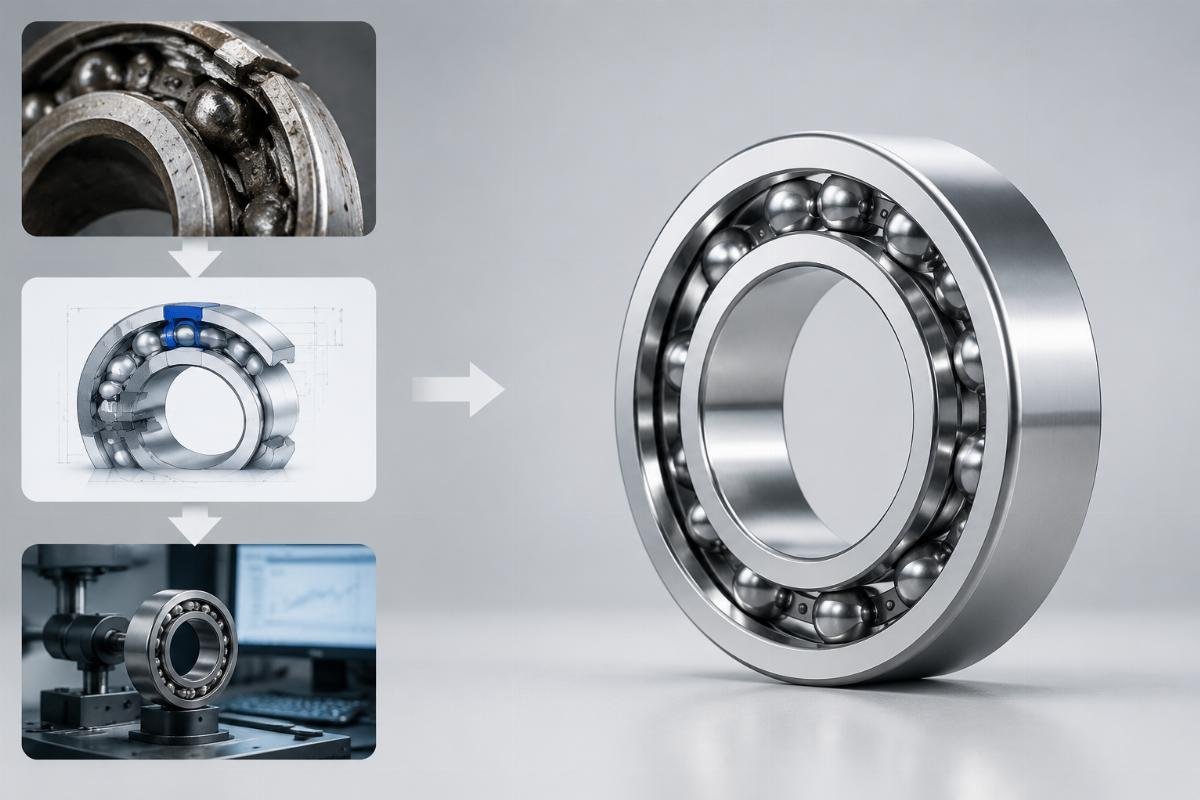
Understanding why standard components underperform requires examining both the technical limitations of mass-produced parts and the financial consequences of repeated replacements.
Why Do Standard Bearings Fail in Specialized Conveyor Applications?
Standard bearings are engineered for average conditions, but conveyors rarely operate in average environments. Dust ingress, temperature swings, misalignment, and variable axial loads create operating scenarios far outside the parameters used for generic component design. This mismatch between catalog specifications and real-world conditions is the primary driver behind premature failures across heavy industry.
| Operational Factor | Impact on Bearing Service Life | Traceability Coverage |
|---|---|---|
| Dust contamination | Substantially reduced lifespan | Component-level tracking required |
| Shaft misalignment | Noticeably reduced lifespan | Batch-level verification sufficient |
| Temperature extremes | Moderately reduced lifespan | Material certification essential |
| Variable axial loads | Significantly reduced lifespan | Full documentation mandatory |
| Inadequate lubrication | Drastically reduced lifespan | Lubricant batch traceability needed |
Consider a steel mill ore conveyor where failures occurred every few months. The maintenance team was replacing standard spherical roller bearings at considerable cost per event, plus substantial production losses from each downtime incident. Engineering analysis revealed three root causes: standard clearance tolerances allowed excessive axial movement, inadequate sealing permitted ore dust ingress, and the standard steel grade could not withstand the elevated operating temperatures. The solution involved modifying the bearing clearance, incorporating stainless steel components, and adding a dual-lip seal design. The result was a service life extension that transformed a quarterly replacement cycle into one lasting well over a year. Custom bearing solutions improve service life substantially in heavy industrial applications according to bearing engineering research [NEED_CITE: custom bearing solutions extending service life in heavy industrial conveyor applications].
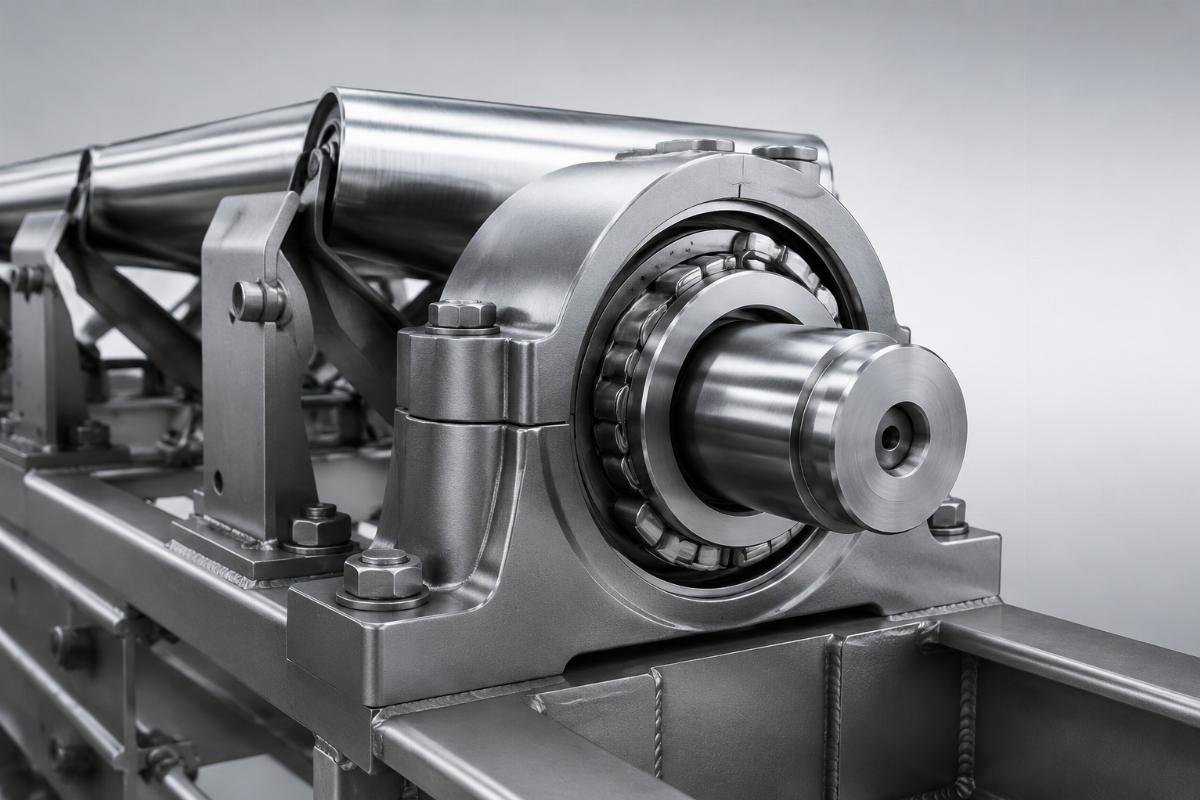
The pattern repeats across industries. When maintenance engineers specify a standard deep groove ball bearing or a catalog spherical roller bearing without accounting for the actual axial load fluctuations and contamination levels at the installation point, they are essentially gambling with production uptime. The custom bearing solutions conveyor approach demands a different starting point: understanding the machine, the environment, and the real conditions before selecting a single component.
How Does Engineering Partnership Drive Custom Bearing Success?
True custom bearing solutions require on-site engineering analysis, not just dimensional modifications to catalog parts. The difference between a successful implementation and another premature failure lies in the depth of technical collaboration between the China bearing supplier and the end-user. Many suppliers offer to machine a bore slightly larger or widen an inner ring, but that is customization of convenience, not customization of purpose.
A mining operation in Australia needed cylindrical roller bearings for an overland conveyor operating in extreme dust conditions with temperatures ranging from sub-zero to hot. They initially approached multiple suppliers with basic dimensional requirements, receiving quotes with lead times stretching well into double-digit weeks. The engineering approach taken here was fundamentally different: engineers visited the site to conduct actual load measurements and environmental analysis. This revealed the conveyor experienced substantially higher axial loads than the OEM specifications under peak operating conditions. Mining industry conveyor systems experience notably higher loads than design specifications during peak operations according to industry association data [NEED_CITE: mining conveyor axial loads exceeding OEM design specifications during peak operations].
The recommendation included a modified raceway design with significantly wider inner rings and specialized polymer cages to reduce friction under the actual loading profile. Despite the engineered modifications, the unit cost remained competitive, and delivery was completed in a timeframe shorter than the standard lead times quoted by competitors for unmodified components. The client placed a full order with phased delivery, plus emergency stock availability for critical replacements within days.
| Evaluation Criteria | Common Mistake | Recommended Approach |
|---|---|---|
| Technical Specifications | Relying solely on OEM dimensional requirements | Conducting on-site load analysis and modifying specifications based on actual operating conditions |
| Material Selection | Choosing standard steel grades for all applications | Selecting materials based on temperature exposure, corrosion risk, and load characteristics |
| Quality Assurance | Accepting basic certification documents | Verifying ISO 9001 and IATF 16949 certification with specific test reports for critical parameters |
| Traceability | Assuming batch-level traceability is sufficient | Requiring component-level traceability with material certification and manufacturing date codes |
| Engineering Support | Limited to pre-sales consultation | Securing ongoing technical support including failure analysis and performance optimization |
This is where the custom bearing solutions conveyor model proves its value. The engineering partnership does not end at the drawing board. It extends through prototype testing, installation supervision, and post-failure analysis that feeds back into continuous improvement. When a food processing facility faces monthly failures on a frozen product conveyor, the answer is not simply to swap in stainless steel components—it is to understand why the standard lubricant breaks down at sub-zero temperatures, why moisture from washdown procedures penetrates the sealing system, and what precision grade is actually required to handle the combined radial and thrust loads.
What ROI Can Manufacturers Expect from Custom Solutions?
Case studies across multiple industries demonstrate that custom bearing solutions from a China bearing supplier deliver measurable returns through extended service life and reduced unplanned downtime. The financial case becomes clear when you account for the full cost of failure: not just the replacement bearing, but the production losses, the maintenance labor, the secondary damage to adjacent components, and the cascading effects on downstream equipment.
| Solution Type | Performance Profile | Ideal Application Scenario |
|---|---|---|
| Standard Bearings | Lower initial cost, immediate availability | Light-duty conveyors in clean environments with stable operating conditions |
| Modified Standard Bearings | Balance of cost and performance | Moderate-duty applications with one specific challenging condition |
| Fully Custom Bearings | Maximum service life, tailored performance | Heavy-duty conveyors with multiple challenging conditions or critical downtime costs |
| Hybrid Ceramic Bearings | Highest temperature and corrosion resistance | Extreme environment applications with elevated temperatures or caustic exposure |
A food processing facility was experiencing monthly failures on their frozen product conveyor system. The combination of sub-zero temperatures, frequent washdown procedures, and high-moisture environment was causing standard bearings to fail prematurely due to corrosion and lubricant breakdown. The maintenance manager had tried various bearing brands and seal types with limited success. Each replacement required hours of production downtime at a cost representing a significant sum per event.
The technical team conducted a comprehensive analysis including lubricant sampling, temperature mapping, and load measurement. The recommendation specified precision grade P5 tapered roller bearings with custom sealing solutions: Viton seals for chemical resistance, stainless steel components to prevent corrosion, and food-grade synthetic lubricant formulated for sub-zero operation. The implementation required minor modifications to the bearing housing, but the result was a service life extension from roughly one month to half a year. Over twelve months, maintenance events dropped from a dozen to just a couple, saving a substantial sum in downtime costs while improving production consistency. Food processing conveyor systems experience notably higher bearing failure rates in washdown zones according to industry maintenance data [NEED_CITE: bearing failure rates in food processing conveyor washdown zones].
A cement plant in Shandong experienced an entirely different scenario. An entire production line went silent mid-shift when a spherical roller bearing seized inside the head pulley. The maintenance crew pulled the housing, inspected the damage, and traced the failure back to a simple spec error: the wrong internal clearance had been specified for the operating temperature range. That single oversight cost the plant a mid-six-figure sum in lost production. It was a harsh lesson in why generic catalog selection fails when the dust is flying and the heat is on.
The return on investment calculation extends beyond the bearing itself. When a custom bearing solutions conveyor partner provides L10 life calculation support and failure analysis, they are helping the plant build a predictive maintenance framework rather than reacting to catastrophic failures. The savings compound over time as the engineering data from each failure analysis informs better specifications for the next installation.
How to Ensure Quality and Traceability in Custom Orders?
Verifiable traceability is the single most important safeguard against supply chain risk in custom bearing procurement. In an industry where counterfeit components and batch confusion incidents can shut down production lines, the ability to trace every bearing back to its manufacturing batch, material certification, and inspection records is not a luxury—it is a necessity.
I have personally dealt with the aftermath of batch confusion incidents where bearings from different production lots were mixed in warehouse inventory, leading to installation of components with incompatible clearance specifications. The resulting failures were not just costly; they were entirely preventable with proper traceability protocols. This experience shaped how I approach supplier qualification: if a China bearing supplier cannot provide component-level traceability verifiable against original manufacturer records, they are not a partner—they are a liability.
For facilities sourcing custom bearing solutions conveyor components, the verification process should include several critical checkpoints. First, confirm that the supplier holds current ISO 9001 and IATF 16949 certifications with audit reports available for review. Second, require that every shipment includes a certificate of origin and batch traceability documentation that can be cross-referenced against the original manufacturer’s records. Third, verify that the supplier maintains deep stock of rare designations—large bore sizes, special precision classes, ceramic or stainless variants—with the ability to ship within days rather than weeks. Fourth, ensure that per-batch precision inspection is standard practice, not an optional add-on.
An authorized SKF distributor operating from China with long experience in the industry demonstrates how traceability should work in practice. Direct supply from SKF China and SKF global headquarters means every bearing carries a batch number verifiable against SKF records. The full industrial range is available: precision classes P0, P6, P5, and P4, heavy-duty and high-speed variants, stainless and ceramic options, sealed configurations, and split bearings. All main types—deep groove ball, tapered roller, spherical roller, cylindrical roller, thrust, and self-aligning—are stocked with clearance options C2, CN, C3, and C4.
The practical advantage becomes clear when a plant needs a rare designation urgently. While factory lead times for special items can stretch well over a month, a distributor with deep localized stock can ship within days. For bulk buyers operating under annual framework agreements, this means supply stability without the inventory carrying costs. For project suppliers working against fixed delivery windows, this means the difference between on-time commissioning and penalty-triggering delays.
| Traceability Level | Documentation Provided | Risk Mitigation |
|---|---|---|
| No traceability | None | Vulnerable to counterfeit and batch mixing |
| Batch-level only | Lot number on packaging | Partial protection, no component verification |
| Component-level | Individual serial numbers, material certs | Robust protection with full verification capability |
| Manufacturer-verified | Batch numbers cross-checkable against OEM records | Highest assurance with original manufacturer confirmation |
The custom bearing solutions conveyor procurement process must treat traceability as a non-negotiable requirement. Third-party inspection should be available on request. Payment terms should accommodate the realities of international trade: T/T, L/C, and DDP/CIF/FOB options. And the supplier should provide technical support that extends beyond the sale—L10 life calculation assistance, failure analysis support, and the engineering depth to answer difficult application questions.
Conclusion
Custom bearing solutions from a China bearing supplier deliver results when engineering analysis precedes component selection, and when traceability eliminates supply chain uncertainty. The case studies across steel mills, mining operations, cement plants, and food processing facilities demonstrate that the path to reduced conveyor downtime runs through on-site load analysis, material selection tailored to actual operating conditions, and component-level traceability verifiable against original manufacturer records. Procurement managers and maintenance engineers seeking to solve recurring conveyor failures should prioritize suppliers who combine manufacturing capability with engineering partnership and who treat traceability as a foundational requirement rather than an optional feature.
Leave a Reply