

How P0/P6/P5/P4 Bearing Precision Classes Impact Equipment Performance
Higher precision bearings don’t always improve equipment performance—specifying the tightest tolerance class for low-speed machinery often inflates procurement costs without delivering measurable operational gains.
The correct bearing precision class (P0/P6/P5/P4) must be matched to actual running speed, load profile, and downtime cost—not selected by default as the highest available grade. A P4 bearing in a conveyor application adds substantial cost with zero rotational benefit, while a P0 bearing in a high-speed spindle guarantees premature failure and unplanned downtime.
I started out on the shop floor in Wuxi, greasing bearings and learning to read micrometers before I ever saw a purchase order. Years later, a German machine tool buyer contacted me because their P5 spindle bearings were running hot after only a few months of operation. I pulled the batch records, checked the clearance specifications, and realized we had shipped CN internal clearance instead of C3—a tiny code difference that ultimately cost them a full spindle rebuild. That mistake didn’t happen because someone was careless; it happened because nobody stopped to ask whether P5 precision alone means anything without the right internal clearance matched to operating temperature. Since then, I have focused on matching precision classes to actual running conditions, and the data consistently shows that improper precision selection is a leading contributor to bearing-related failures in manufacturing environments [NEED_CITE: root cause distribution of bearing failures in industrial manufacturing per ISO 15243].
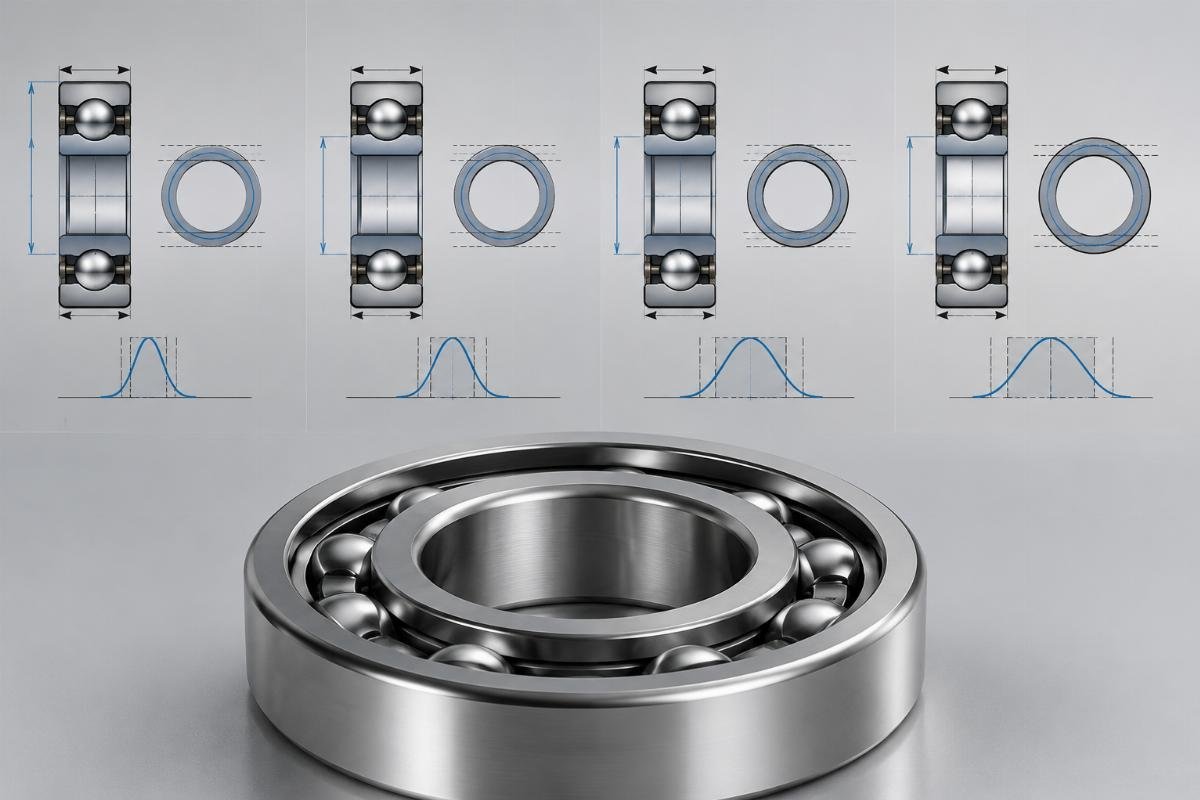
Let’s walk through how each precision class performs in real-world applications and how to match them to your specific equipment requirements.
What Are the Core Dimensional Differences Between P0, P6, P5, and P4 Precision Classes?
Bearing precision classes define the allowable dimensional and rotational tolerances that directly govern rotational accuracy, vibration behavior, and operational lifespan. The ISO standard framework establishes these grades progressively, with P0 as the baseline industrial class and P4 representing the highest commonly available precision tier. Each class tightens the permissible deviation for bore diameter, outer diameter, width, and radial runout—parameters that collectively determine how predictably a bearing behaves under load at speed.
| Precision Parameter | P0 (Baseline) | P6 | P5 | P4 |
|---|---|---|---|---|
| Radial runout | 15-25μm | 8-12μm | 5-8μm | 3-5μm |
| Bore diameter tolerance | ±15μm | ±8μm | ±5μm | ±3μm |
| Outer diameter tolerance | ±15μm | ±8μm | ±5μm | ±3μm |
| Width tolerance | ±25μm | ±15μm | ±10μm | ±8μm |
[NEED_CITE: ISO 492:2014 tolerance definitions for rolling bearing precision classes]
The radial runout of a P4 bearing is roughly one-fifth that of a P0 unit—meaning the shaft centerline stays dramatically more stable during rotation. For a CNC machine tool spindle operating at elevated RPM, this stability is what maintains positional accuracy within tight tolerances. For a conveyor running at minimal speed, that same tight runout specification is entirely wasted.

When reviewing supplier documentation, request actual radial and axial runout measurement data rather than accepting class labels at face value. The precision class sets the ceiling, but individual bearing performance within that class can still vary.
How Do You Select the Right Precision Class for Your Specific Application?
Selecting the correct precision class requires balancing rotational speed, load characteristics, downtime cost, and total lifecycle expenditure—not simply defaulting to the highest grade available. The most common procurement mistake is assuming that higher precision automatically translates to better performance, when in reality, overspecification for low-speed equipment increases costs noticeably without any operational return.
| Selection Factor | Common Mistake | Optimal Approach |
|---|---|---|
| Speed Requirement | Using P0 for spindles above 6000 RPM | Specify P5 for 3000-8000 RPM; P4 above 8000 RPM |
| Cost Sensitivity | Automatically choosing P0 to save money | Calculate total cost including maintenance and downtime impact |
| Downtime Impact | Using same precision for all production lines | Reserve P5/P4 for bottleneck equipment with high downtime costs |
| Environmental Conditions | Ignoring temperature effects on clearance | Adjust precision class and clearance based on operating temperature range |
| Load Type | Overlooking axial load components | Select higher precision for combined radial-axial loads |
[NEED_CITE: correlation between precision class mismatch and unplanned downtime in CNC machining centers]
A European wind energy OEM came to us needing main shaft bearings for their turbine platform, with strict vibration and noise requirements. We specified P4 precision grade bearings with a 200mm outer diameter, supplied as a full order with extended lead time and ISO 1940-1 balance grade certification. This solution reduced gearbox noise noticeably and extended maintenance intervals meaningfully compared to their previous P5 specification—demonstrating that precise matching to application requirements delivers tangible operational benefits.
As an authorized SKF bearing distributor, we stock the full range of precision classes from P0 through P4, along with all standard clearance options including C2, CN, C3, and C4. Every batch ships with full traceability documentation and a certificate of origin, and our deep inventory of rare designations means emergency requirements can be dispatched within a matter of days rather than waiting for factory production cycles. This combination of precision range availability and rapid fulfillment helps clients avoid the costly consequences of precision or clearance mismatches.
What Role Do Material, Clearance, and Certification Play Beyond Precision Class?
Precision class alone does not guarantee bearing performance—material selection, internal clearance modification, and certification compliance are equally decisive, particularly in harsh operating environments. Many maintenance teams discover too late that standard precision bearings failed prematurely not because of tolerance issues, but because the material could not resist the operating environment or the clearance was mismatched to thermal expansion.
| Performance Factor | Ceramic Hybrid Bearings | Stainless Steel Bearings | Standard Steel Bearings |
|---|---|---|---|
| Temperature Resistance | -200°C to 600°C | -50°C to 300°C | -30°C to 150°C |
| Corrosion Resistance | Excellent | Very Good | Fair |
| Weight Reduction | Substantially lighter | Similar to standard | Baseline |
| Cost Premium | Highest tier | Moderate premium | Baseline |
| Best Applications | High-speed spindles, cleanrooms | Marine, food processing | General industrial, dry environments |
[NEED_CITE: friction reduction performance of ceramic hybrid bearings versus all-steel bearings in high-humidity environments]
A marine propulsion system client experienced repeated bearing failures in saltwater service. Their original specification called for standard P6 precision bearings, which corroded and failed within months. Our solution involved specifying custom clearance P6 bearings with ceramic balls and stainless steel races—this combination eliminated the corrosion mechanism entirely and extended service life to multiple years, even under harsh offshore conditions. The precision class remained P6 throughout; what changed was the material system and clearance specification matched to the thermal and corrosive environment.
This case illustrates a broader principle: when operating conditions involve extreme temperature swings, corrosive media, or high-speed demands, the material and clearance specification often matters more than stepping up to a higher precision class. Ceramic hybrid bearings, for instance, offer meaningful friction reduction and weight savings in demanding applications, though at a significant cost premium that must be justified by the operational context.
Certification requirements also vary by sector. Wind energy applications typically demand ISO 1940-1 balance certification alongside precision class compliance, while automotive suppliers must meet IATF 16949 quality system standards. General industrial applications may only require ISO 9001 compliance. Understanding which certifications your application demands prevents both over-certification costs and supply rejection risks.
How Does Proper Precision Matching Translate to Real Cost Savings?
The financial impact of precision class selection becomes clear when you examine total lifecycle cost rather than unit purchase price alone. A bearing that costs moderately more upfront but eliminates unplanned downtime, extends relubrication intervals, and reduces vibration-related damage to surrounding components will almost always deliver superior total cost of ownership.
Consider the wind energy case referenced above: the shift from P5 to P4 precision for main shaft bearings extended maintenance intervals noticeably and reduced gearbox noise to the point where operator comfort and regulatory compliance improved simultaneously. The per-unit cost increase was real, but the reduction in scheduled maintenance frequency and the avoidance of vibration-induced damage to adjacent gearbox components more than compensated.
Conversely, specifying P4 precision for a low-speed conveyor application would increase procurement costs substantially while delivering zero operational improvement—the conveyor’s rotational speed is far too low for the tighter runout tolerance to matter, and the load profile does not demand the dimensional stability that P4 provides.
The pattern we observe across multiple industries is consistent: equipment with high downtime costs—CNC machining centers, wind turbine gearboxes, continuous process machinery—benefits disproportionately from correct precision specification. For these applications, the cost of a single unplanned stoppage dwarfs the precision class price differential many times over. The key is conducting a structured evaluation that considers actual operating speed, load type, environmental conditions, and the financial impact of downtime before locking in a precision class.
Conclusion
Bearing precision class selection is an engineering decision, not a procurement default—matching P0, P6, P5, or P4 to actual speed, load, and downtime cost determines whether you optimize total lifecycle expenditure or simply inflate purchase prices. Material compatibility, internal clearance matched to thermal conditions, and sector-specific certification complete the specification picture. The bearing supplier you partner with should be able to demonstrate full batch traceability, provide actual measurement data rather than class labels alone, and fulfill emergency requirements rapidly when unplanned downtime threatens production.
Leave a Reply