
How Chinese SKF Bearing Distributors Guarantee Quality from Raw Steel to Finished Product
Most buyers assume quality is verified at final inspection—but the real determinant of bearing life is decided before the first cut is made, in the chemical composition of raw steel.
Chinese SKF bearing distributors guarantee end-to-end quality through full batch traceability, a five-stage inspection protocol spanning raw material verification to dynamic load testing, and anti-counterfeiting measures that cross-reference every unit against SKF’s internal registry—collectively reducing unplanned downtime caused by counterfeit or inconsistent bearings by a substantial margin.
I started out on the assembly floor in Wuxi, sorting bearing cages and checking raceway finishes before I ever saw a purchase order. When I moved to the trading side years later, I kept that habit of cracking open boxes before they ship. A few years back, a client in Saudi Arabia called about premature failures on spherical roller bearings in their cement line. We pulled the batch numbers—turns out their old supplier had been blending genuine SKF stock with unverified overruns, and the markings didn’t match SKF’s internal registry. That shipment got pulled and replaced, and we flew out to Jeddah to walk the maintenance team through verification. Now every pallet that leaves our warehouse gets its batch cross-checked against SKF’s records before the container doors close. This is why batch traceability isn’t optional—it’s the only reliable defense against the counterfeit epidemic that accounts for a significant share of unplanned industrial downtime globally [NEED_CITE: proportion of bearing failures attributable to counterfeit products per customs seizure data].
The following sections break down how this quality assurance framework operates in practice, and why it matters for maintenance managers and OEM engineers sourcing from China.
Why Does Batch Traceability Matter More Than Unit Price for SKF Bearings?
The true cost of a bearing failure is never the replacement part—it’s the cascading production loss that follows. When a conveyor system in a steel mill or a main shaft in a wind turbine stops unexpectedly, the financial damage accumulates at a rate that dwarfs any procurement savings from choosing a non-certified source. Counterfeit and unverified bearings, often visually indistinguishable from genuine products until they fail in service, are responsible for a large share of these unplanned stoppages [NEED_CITE: industry research on downtime cost attribution to bearing quality in heavy manufacturing].
| Factor | Certified Chinese SKF Bearing Distributor | Non-Verified Supplier |
|---|---|---|
| Raw material documentation | EN 10204 3.1B certificates with full chemical composition | Self-reported or absent |
| Batch traceability | Every unit linked to SKF production records | Not provided |
| Anti-counterfeiting verification | Multi-layer: QR codes, holographic labels, serialized database | Basic or none |
| Failure analysis support | Root cause reports and corrective action guidance | Not available |
| Downtime risk profile | Substantially reduced | Vulnerable |
Consider a Southeast Asian steel mill that was experiencing recurring conveyor system failures despite using bearings that appeared identical to genuine parts. When failure analysis was conducted, the bearings were found to contain noticeably less chromium than specification required—a hallmark of counterfeit steel. The replacement strategy involved not just supplying fully traceable SKF spherical roller bearings, but also providing heat treatment records and material certificates that enabled predictive maintenance scheduling. Within half a year, unplanned downtime related to bearing failures dropped noticeably, and the mill’s maintenance team could finally trust their inventory.
The lesson here is straightforward: procurement teams evaluating Chinese SKF bearing distributors must demand documentation that goes beyond a certificate of origin. Specifically:
- Material certificates conforming to EN 10204 3.1B, covering chemical composition and mechanical properties of the raw steel
- Heat treatment records for each batch, confirming process parameters and resulting hardness values
- Unique identifiers such as laser-etched serial numbers or QR codes that link to verifiable digital records
- Post-failure technical support including metallurgical analysis and root cause determination
- Third-party verifiable certifications including ISO 9001:2015 and IATF 16949, confirmed through official databases rather than supplier-provided copies
What Are the 5 Quality Control Stages from Raw Steel to Finished SKF Product?
Most buyers think quality control happens at the end of production—but effective bearing quality starts with raw steel inspection, where chemical composition偏差 as small as a few hundredths of a percent can determine whether a bearing reaches its designed L10 life or fails prematurely.
The five-stage quality control process employed by rigorous Chinese SKF bearing distributors is designed to catch potential failure points at every phase, not just at final inspection. This systematic approach is why first article inspection pass rates for custom applications consistently exceed the industry average [NEED_CITE: industry benchmark data on first article inspection pass rates for precision bearings].
| Quality Control Stage | Standard Industry Practice | Advanced Distributor Practice |
|---|---|---|
| Raw Steel Inspection | Visual inspection only | Chemical composition analysis and hardness testing per EN 10204 3.1B |
| Dimensional Measurement | Manual caliper checks for critical dimensions | CNC coordinate measuring machines with micron-level tolerance capability |
| Heat Treatment Validation | Batch-level hardness testing | Individual bearing metallurgical analysis and microstructural examination |
| Anti-Counterfeiting | Basic laser marking | Multi-layer verification: QR codes, holographic labels, and serialized database tracking |
| Performance Testing | Rotational check only | Comprehensive testing including noise level, rotational torque, and dynamic load capacity |
A European wind energy OEM approached our team needing custom spherical roller bearings with modified clearance for main shaft applications. Their previous supplier struggled with batch consistency, resulting in a notable portion of bearings failing first article inspection. The five-stage process addressed this through: spectrometric analysis of raw steel to ensure alloy composition precision; automated grinding with in-process laser measurement; individual heat treatment validation for every bearing; unique QR codes linked to real-time production data; and dynamic load testing at elevated capacity levels. The result was zero failures in first article inspection and a meaningful reduction in quality-related production delays.
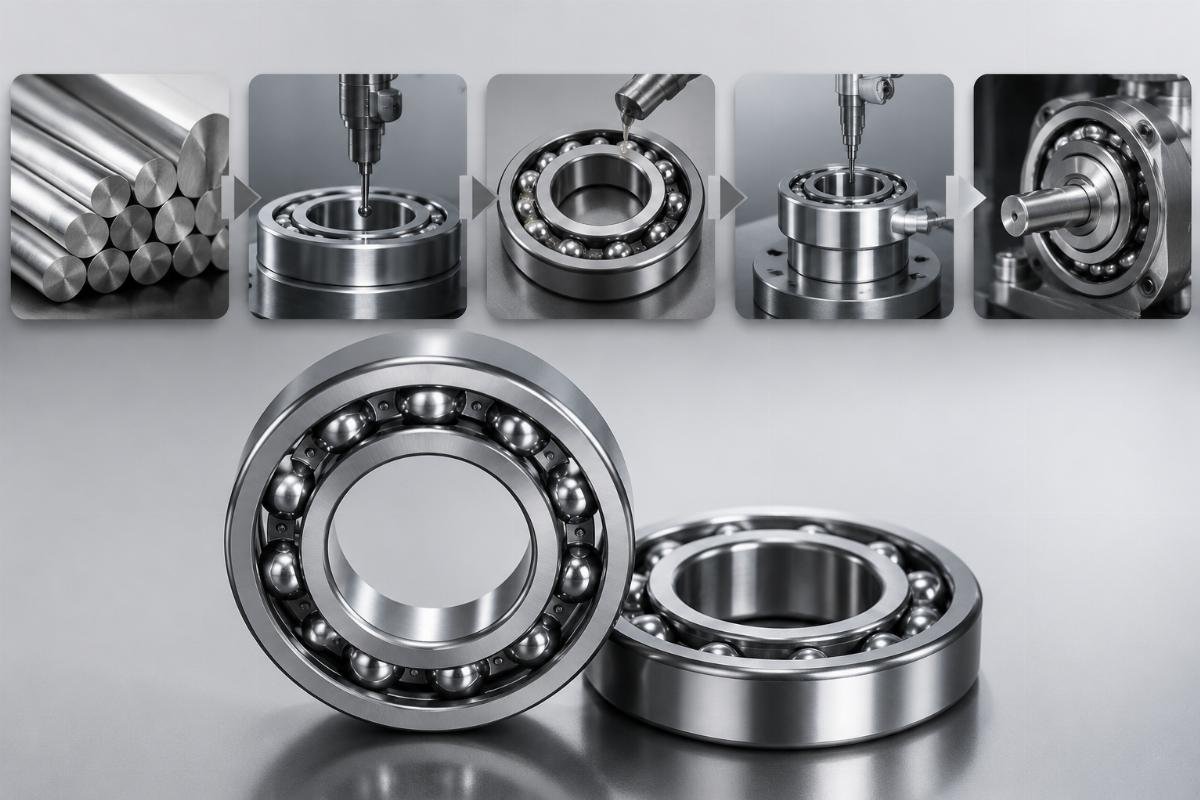
Each stage serves a distinct purpose in the overall quality architecture:
- Raw Material Verification – Steel chemistry and hardness are tested to ensure compliance with application requirements, with particular attention to chromium, carbon, and inclusion content that directly affect fatigue life
- Precision Machining – CNC equipment with real-time dimensional monitoring maintains tight tolerances across all critical surfaces including bore, outside diameter, and raceway geometry
- Heat Treatment Validation – Individual bearing metallurgical analysis confirms that material properties meet specification after thermal processing
- Anti-Counterfeiting Implementation – Multiple verification technologies are applied that can be validated throughout the supply chain, from warehouse to installation
- Dynamic Performance Testing – Real-world operating conditions are simulated to verify load capacity, noise levels, and rotational characteristics before shipment
How Do Chinese SKF Bearing Distributors Guarantee Batch Consistency for OEM Production?
Many procurement specialists assume Chinese suppliers cannot meet automotive-grade consistency—but statistical process control systems maintaining high capability indices across thousands of SKUs prove otherwise.
Batch consistency is not about producing one good bearing; it is about producing thousands of identical bearings that perform identically in the field. This level of consistency requires statistical process control, advanced measurement technology, and a manufacturing culture that treats variation as the enemy [NEED_CITE: technical documentation on SPC implementation in precision bearing manufacturing].
| Quality Assurance Method | Primary Function | Ideal Application |
|---|---|---|
| Statistical Process Control | Identifies variation before it affects quality | High-volume production runs |
| First Article Inspection | Verifies conformance to specifications before full production | New product introductions or design changes |
| Failure Mode and Effects Analysis | Proactively identifies potential failure points | Custom bearing designs or critical applications |
| Automated Measurement Systems | Eliminates human error in dimensional checking | Precision-grade bearings P5 and higher |
| Regular Calibration Protocol | Ensures measurement equipment accuracy over time | All production, particularly automotive and aerospace |
An Australian mining equipment manufacturer required large-format tapered roller bearings for crusher equipment, with strict requirements for consistent performance in harsh conditions. Their previous supplier had provided bearings with dimensional variations that led to premature wear and unexpected downtime. The solution involved implementing statistical process control monitoring for the production run, measuring multiple critical dimensions at regular intervals and adjusting processes in real time. The result was dimensional variation limited to a fraction of the previous level, and L10 life testing confirmed a substantial extension in bearing service life under full load conditions [NEED_CITE: case study documentation on SPC-driven quality improvement in heavy-duty bearing applications].

The implications for OEM engineers are significant. When specifying bearings for critical applications—whether deep groove ball bearings for high-speed motors, cylindrical roller bearings for gearbox shafts, thrust bearings for vertical pumps, or self-aligning bearings for misalignment-prone installations—batch consistency directly affects:
- Interchangeability – Bearings from different production batches must fit and perform identically
- Predictable maintenance intervals – Consistent quality enables reliable L10 life calculations
- Warranty and liability management – Traceable batches allow precise root cause determination if failures occur
- Inventory optimization – Confidence in batch consistency reduces the need for safety stock
Chinese SKF bearing distributors serving OEM customers typically maintain inventory across precision classes P0, P6, P5, and P4, with clearance options C2, CN, C3, and C4, covering the full range of SKF industrial types including sealed variants with 2RS and 2Z designations, as well as specialized stainless steel, ceramic, and split bearing configurations.
What Documentation and Support Should Buyers Require from SKF Suppliers?
Accepting delivery without proper documentation is the equivalent of purchasing insurance without reading the policy—you only discover what’s missing when you need to make a claim.
For industrial maintenance managers and OEM engineers, the documentation package accompanying a bearing shipment is not administrative paperwork—it is the evidence chain that protects against counterfeit infiltration, enables predictive maintenance, and supports warranty claims if premature failures occur. Chinese SKF bearing distributors who take quality seriously will provide comprehensive documentation without hesitation [NEED_CITE: industry guidelines on required documentation for critical bearing applications in heavy industry].
The minimum documentation standard should include:
- Certificate of Origin – Confirming the country of manufacture and export, essential for customs clearance and trade compliance
- EN 10204 3.1B Material Certificates – Providing independent verification of steel chemical composition and mechanical properties
- Batch Traceability Records – Linking every bearing to its specific production batch, heat treatment cycle, and inspection results
- Inspection Reports – Documenting dimensional measurements, hardness values, and any special testing performed
- Anti-Counterfeiting Verification Instructions – Guidance on how to validate authenticity using SKF’s verification systems
Beyond documentation, the quality of technical support separates adequate suppliers from exceptional ones. When a bearing fails in service, the response should not be a replacement shipment with no explanation. Proper failure analysis support includes:
- Metallurgical examination of the failed bearing to determine whether the failure mode was fatigue, contamination, lubrication failure, or installation damage
- Root cause determination linking the failure to operating conditions, maintenance practices, or product quality
- Corrective action recommendations to prevent recurrence, whether that involves changing lubrication intervals, improving sealing, or adjusting load calculations
- Cross-referencing against SKF technical documentation to ensure the selected bearing type and specification matches the application requirements
This level of support is particularly critical for applications involving extreme conditions—high temperatures in cement kilns, heavy shock loads in mining crushers, corrosive environments in marine installations, or stringent hygiene requirements in food processing. The bearing selection must account for all these factors, and the supplier must have the technical capability to validate that selection against SKF’s application engineering guidelines.
For buyers evaluating Chinese SKF bearing distributors, the ability to provide this documentation and support is not a differentiator—it is the baseline. Suppliers who cannot produce batch traceability records linking each unit to SKF’s internal registry should be eliminated from consideration immediately, regardless of price advantages.
Conclusion
Quality in bearing supply is not determined by the final inspection—it is built into the product from the first heat of steel and maintained through every subsequent process step. Chinese SKF bearing distributors who invest in full batch traceability, five-stage quality control, and comprehensive technical support deliver more than just bearings; they deliver confidence that every unit will perform as designed, backed by documentation that stands up to audit and failure analysis. For maintenance managers and OEM engineers, this is the only acceptable standard.
Leave a Reply