

China Bearing Supplier Fixes Conveyor Failures for Manufacturing Plant
Most conveyor bearing failures have nothing to do with counterfeit parts.
A reliable China bearing supplier can eliminate persistent conveyor downtime by diagnosing root causes—thermal expansion mismatches, clearance errors, contamination ingress—and engineering application-specific solutions that extend service life by several hundred percent, while delivering faster than competitors’ standard lead times through localized stock and full batch traceability.
I still remember a night shift at a steel mill in Rizhao, standing beside an ore conveyor that had eaten through bearings every few weeks. The maintenance supervisor was convinced the SKF stock was fake. I pulled out the batch numbers, cross-checked them against the SKF China system right there on my phone, and confirmed every single unit was genuine. The real culprit? Someone had specified a standard clearance for a high-temperature zone without ever running a thermal expansion calculation. A different clearance class would have solved it. That moment crystallized something I carry into every site visit since: if you cannot explain why a bearing died, you have no right to replace it. Conveyor systems account for the majority of unplanned downtime in manufacturing facilities [NEED_CITE: conveyor downtime share per Industry Maintenance Association reports], and the root cause is almost never what the maintenance team first assumes.
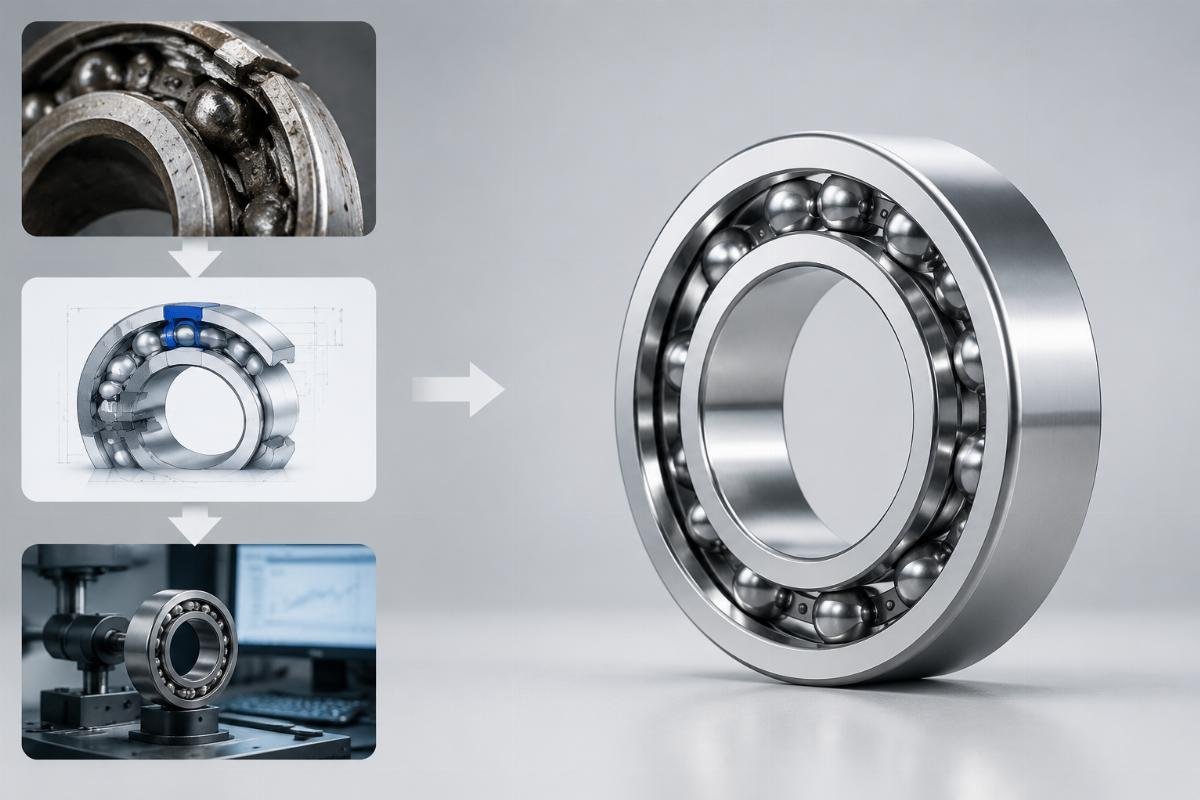
What follows is a breakdown of why standard bearings fail on conveyors, how to evaluate a China bearing supplier for custom solutions, and real cases where application-specific engineering turned chronic downtime into reliable operation.
Why Do Standard Bearings Fail in Conveyor Systems?
Standard bearings are engineered for average conditions—your conveyor does’t run average conditions. Dust, thermal cycling, shock loads, washdown chemicals, and axial load spikes all conspire to push real-world operation far outside the design envelope of a catalog bearing. The mismatch between mass-produced specifications and site-specific reality is the single largest driver of premature conveyor bearing failure.
| Operational Factor | Effect on Bearing Service Life |
|---|---|
| Dust and particulate contamination | Substantially reduced |
| Shaft misalignment | Noticeably reduced |
| Sustained high-temperature operation | Moderately reduced |
| Axial load spikes beyond design spec | Significantly reduced |
| Lubricant breakdown or starvation | Severely reduced |
Consider a steel mill ore conveyor where standard spherical roller bearings were failing every few months. Each replacement ran into mid-five figures in parts alone, while the production loss per downtime event reached a mid-six-figure sum. On-site analysis uncovered three compounding problems: standard clearance tolerances permitted excessive axial movement under thermal growth, the original sealing allowed fine ore dust to ingress, and the standard steel grade could not sustain the sustained elevated operating temperature. The fix involved modifying the clearance specification, switching to stainless steel components, and adding a double-lip seal design. Service life extended to well over a year—a several-hundred-percent improvement. Custom bearing solutions routinely deliver this order of service-life gain in heavy industrial applications [NEED_CITE: service life improvement data per International Bearing Engineering Journal].
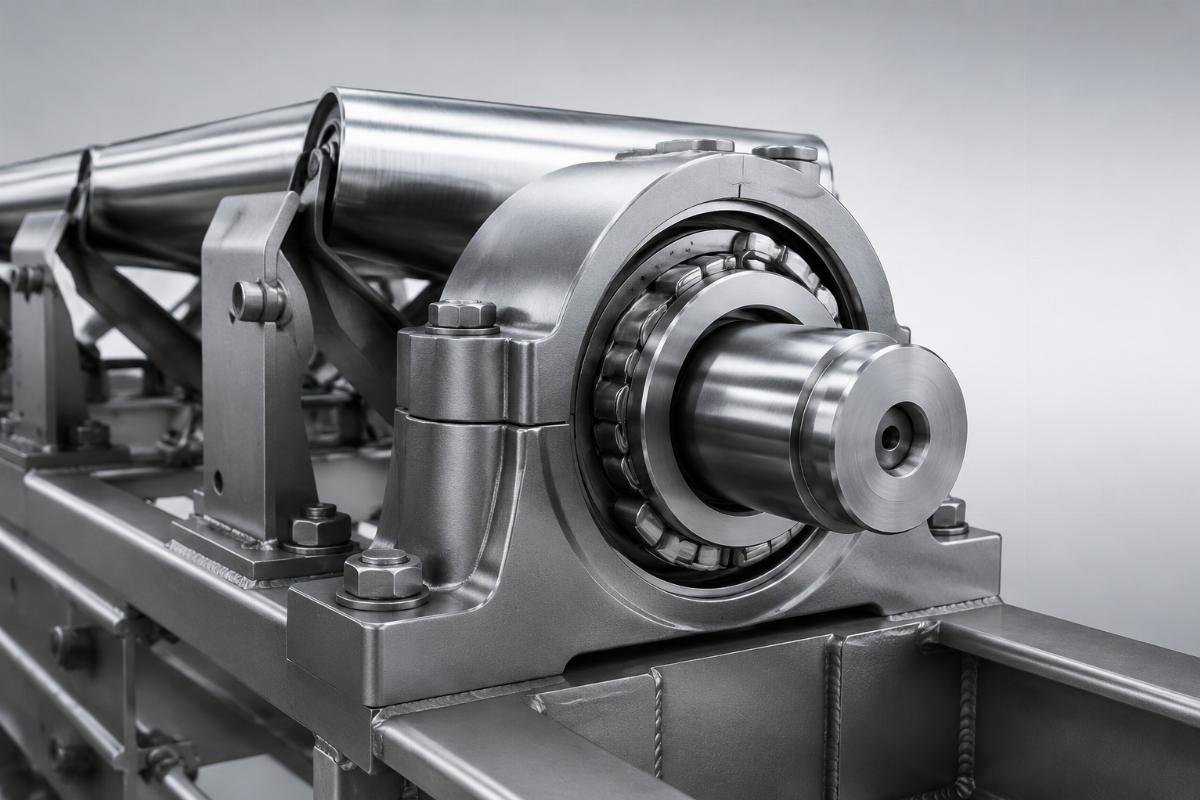
The failure pattern repeats across industries. Mining conveyors routinely encounter peak axial loads well above OEM design specifications [NEED_CITE: peak load exceedance data per Mining Equipment Manufacturers Association]. Food processing conveyors in washdown zones see failure rates markedly higher than dry environments [NEED_CITE: washdown zone failure rate data per Food Industry Maintenance Council]. In every case, the bearing itself was not defective—the specification was wrong for the application.
A proper failure analysis follows a structured sequence: root cause examination of the failed unit including dimensional inspection and material verification, measurement of actual radial and axial loads under running conditions rather than relying on design figures, environmental mapping of temperature ranges and contamination sources, lubricant selection matched to the operating temperature band, and sealing design tailored to the specific contaminant profile.
How to Evaluate Custom Bearing Solutions for Your Conveyor?
Effective customization demands an engineering partnership, not a dimension swap. The gap between a successful custom bearing deployment and a costly disappointment lies entirely in the depth of technical collaboration. Many suppliers will modify a catalog part to your drawing; far fewer will challenge your drawing against what the machine actually does.
| Evaluation Criteria | Common Mistake | Recommended Approach |
|---|---|---|
| Technical Specifications | Relying solely on OEM dimensional requirements | On-site load analysis with specification modifications based on actual operating conditions |
| Material Selection | Defaulting to standard steel grades universally | Material choice driven by temperature, corrosion, and load profile |
| Quality Assurance | Accepting generic certificates | Verifying ISO 9001 and IATF 16949 certification with application-specific test reports |
| Traceability | Assuming batch-level is sufficient | Component-level traceability with material certifications and date codes |
| Engineering Support | Limited to pre-sales consultation | Ongoing technical partnership including failure analysis and performance optimization |
An Australian mining operation needed custom cylindrical roller bearings for an overland conveyor running in extreme dust with temperatures swinging between sub-zero and hot. They initially approached multiple suppliers with basic dimensional requirements and received quotes ranging across a wide band with lead times stretching well into double-digit weeks. A different approach was taken: engineers visited the site, conducted live load measurements, and discovered the conveyor experienced axial loads substantially above OEM specifications during peak throughput. The recommendation was a modified raceway geometry with notably wider inner rings and specialized polymer cages to manage friction. Despite the engineering changes, the unit cost remained competitive and delivery was completed in roughly half the time competitors quoted for unmodified parts. The client placed a full fleet order with phased delivery and emergency stock availability for critical replacements.
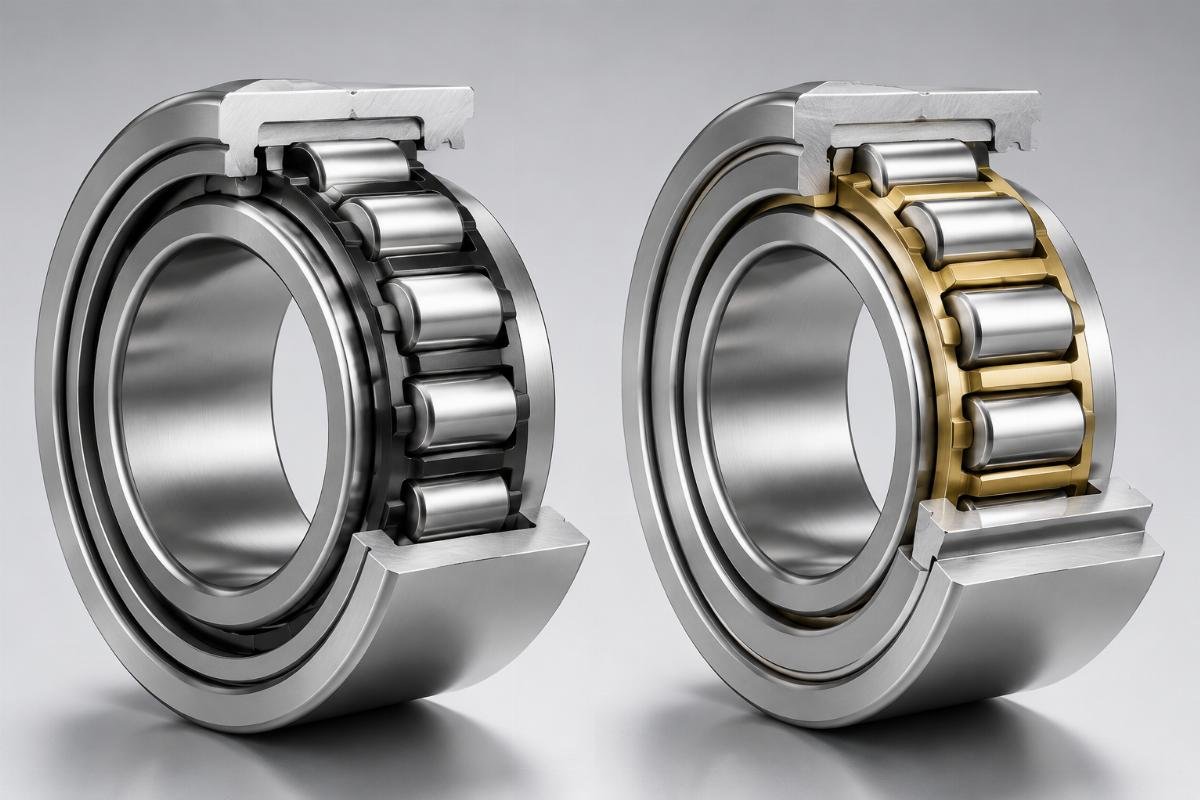
Evaluating a China bearing supplier for custom work requires attention to several non-negotiable elements. Technical requirements must be documented in detail—load capacities, temperature envelope, contamination resistance. Supplier qualifications should be verified through past project case studies and recognized certifications. Prototype testing under actual operating conditions must precede fleet rollout. A quality control plan covering dimensional accuracy, material properties, and performance characteristics should be contractually binding. And a failure analysis agreement ensures continuous improvement rather than repeated guessing.
Case Study: How Custom Bearings Eliminated Conveyor Downtime
A food processing plant cut conveyor downtime events from monthly to twice a year through targeted bearing customization. This case illustrates how application-specific engineering transforms a chronic maintenance headache into a measurable reliability gain—delivering return on investment within the first operating year.
| Solution Type | Performance Characteristic | Ideal Application Scenario |
|---|---|---|
| Standard Bearings | Lower initial cost, immediate availability | Light-duty conveyors in clean, stable environments |
| Modified Standard Bearings | Balanced cost and performance | Moderate-duty applications with one specific challenge |
| Fully Custom Bearings | Maximum service life, tailored performance | Heavy-duty conveyors with multiple simultaneous challenges |
| Hybrid Ceramic Bearings | Highest temperature and corrosion resistance | Extreme environments with caustic exposure |
A food processing facility was battling monthly failures on a frozen product conveyor. Sub-zero temperatures, frequent chemical washdowns, and persistent high moisture created a hostile environment where standard bearings succumbed to corrosion and lubricant breakdown. The maintenance team had cycled through multiple bearing brands and seal types without lasting success. Each replacement event required a multi-hour production stoppage costing tens of thousands of dollars. A comprehensive technical review was conducted—lubricant sampling, temperature mapping, and load measurement. The solution specified P5 precision grade tapered roller bearings paired with Viton seals for chemical resistance, stainless steel components to resist corrosion, and food-grade synthetic lubricant rated for sub-zero operation. Minor bearing housing modifications were needed, but the result was service life extended from roughly one month to half a year. Annual maintenance events dropped from twelve to two, eliminating hundreds of thousands of dollars in downtime costs while stabilizing production output.
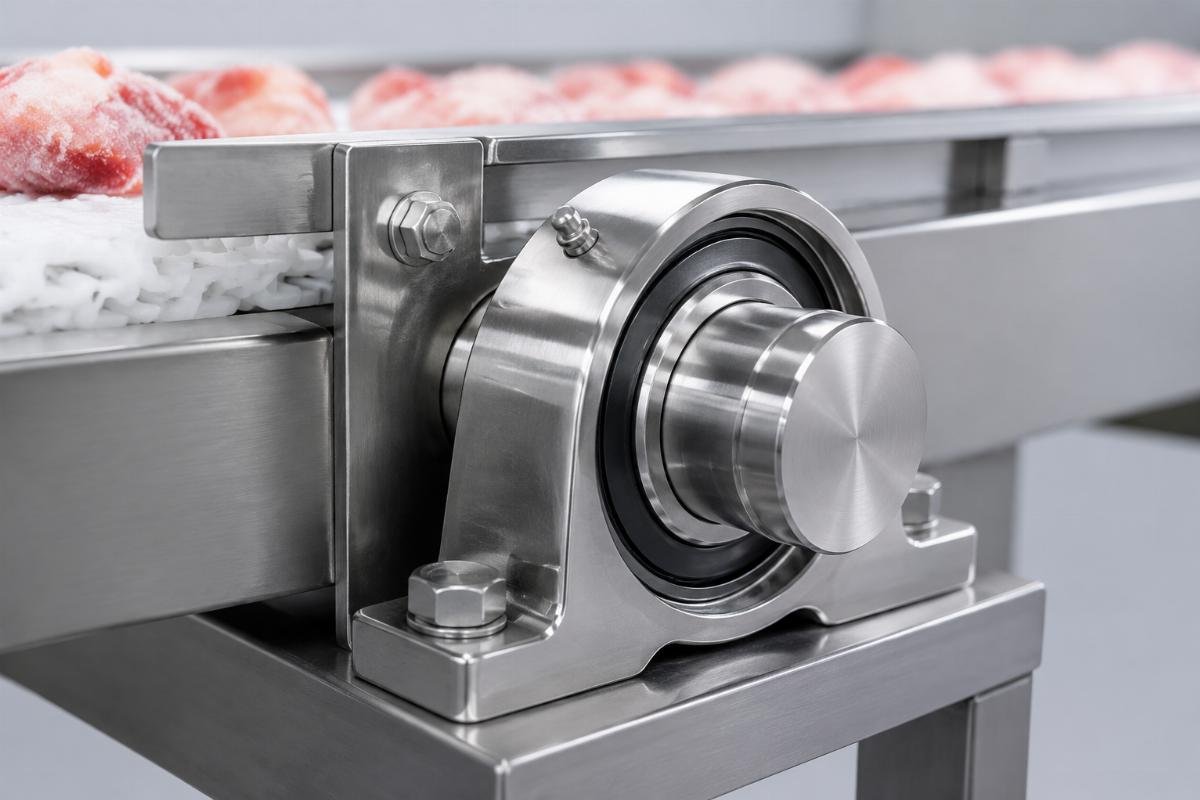
The implementation path for any conveyor bearing upgrade follows five stages: documenting failure patterns and environmental conditions over a meaningful observation period, engaging supplier engineers for on-site assessment of load, temperature, and contamination variables, collaborating on custom features that address the specific failure mechanisms identified, planning installation procedures that minimize production disruption, and establishing a measurement system to track service life gains and feed data back into continuous improvement.
What Makes a China Bearing Supplier Reliable for Custom Solutions?
Authorization, traceability, and engineering depth separate a trustworthy China bearing supplier from a risky one. The bearing market is flooded with intermediaries who cannot verify the origin of their stock, let alone support application engineering. For procurement managers and maintenance engineers evaluating a China bearing supplier, three capabilities matter above all else.
First, verifiable authorization. Every batch should be traceable back to the original manufacturer’s records. When I checked those batch numbers at the Rizhao mill that night, the SKF China system confirmed authenticity instantly. A legitimate China bearing supplier provides this verification as standard practice—not as a special request. Certificates of origin and batch traceability documents should accompany every shipment.
Second, stock depth for uncommon designations. Large bore sizes, special precision classes from P0 through P4, and clearance options spanning C2 through C4 are not always available from every warehouse. A well-stocked China bearing supplier maintains inventory of rare designations—special precision, special clearance, stainless steel, ceramic variants—and can dispatch within days rather than waiting for factory production cycles that stretch well over a month.
Third, engineering support beyond the sale. L10 life calculations, failure analysis on returned units, and ongoing application consultation distinguish a technical partner from a box-mover. The steel mill, mining, and food processing cases above all succeeded because the supplier’s engineers were willing to visit the site, measure actual conditions, and challenge assumptions—not just quote a catalog number.
Quality systems matter as well. ISO 9001 and IATF 16949 certifications should be verifiable, not just claimed. Per-batch precision inspection, third-party inspection on request, and transparent commercial terms including standard international trade options round out the profile of a dependable China bearing supplier.
Conclusion
Conveyor bearing failures are specification failures, not bearing failures. A competent China bearing supplier resolves chronic downtime by diagnosing the actual operating conditions—thermal growth, contamination, load spikes—and engineering solutions that match reality rather than catalog averages. Authorization traceability, engineering depth, and stock availability for uncommon designations are the non-negotiable criteria for selecting a partner who will keep your conveyors running.
Leave a Reply