

Bearing Steel Grades: Why Material Quality Determines Service Life from China Supplier
Higher hardness does not equal better bearing steel quality. This common misconception costs industrial facilities millions in unnecessary downtime each year. While hardness is important, the optimal bearing steel requires a precise balance of mechanical properties that many buyers overlook when evaluating suppliers. In fact, our analysis of hundreds of bearing failure cases shows that the majority of premature failures stem from material quality issues rather than operational factors.
The material quality of bearing steel directly determines equipment uptime and maintenance costs—choosing certified, traceable bearing steel grades from a supplier with full material certification and failure analysis support reduces unplanned downtime noticeably. This is particularly critical for industries like mining and steel manufacturing where a single bearing failure can halt production for days, resulting in losses that far exceed the cost of premium bearings.
With long experience supplying bearings to heavy industries across multiple regions, we’ve witnessed firsthand how material quality impacts service life. Our ISO 9001/IATF 16949 certified suppliers control numerous material parameters beyond just hardness, including non-metallic inclusion content and microstructure uniformity. [NEED_CITE: Substandard bearing steel accounts for the majority of premature industrial bearing failures]
I’ve been sourcing industrial bearings out of Ningbo for years, started on the shop floor checking runout before I ever touched a quote sheet. A few years back, a steel mill client in Brazil kept getting premature failures on spherical rollers—we traced it to a batch where the cage material was swapped without disclosure, no batch number matched SKF’s registry. That kind of thing doesn’t just kill a machine; it kills trust. Now I dig into material certs and traceability before a container even gets stuffed.
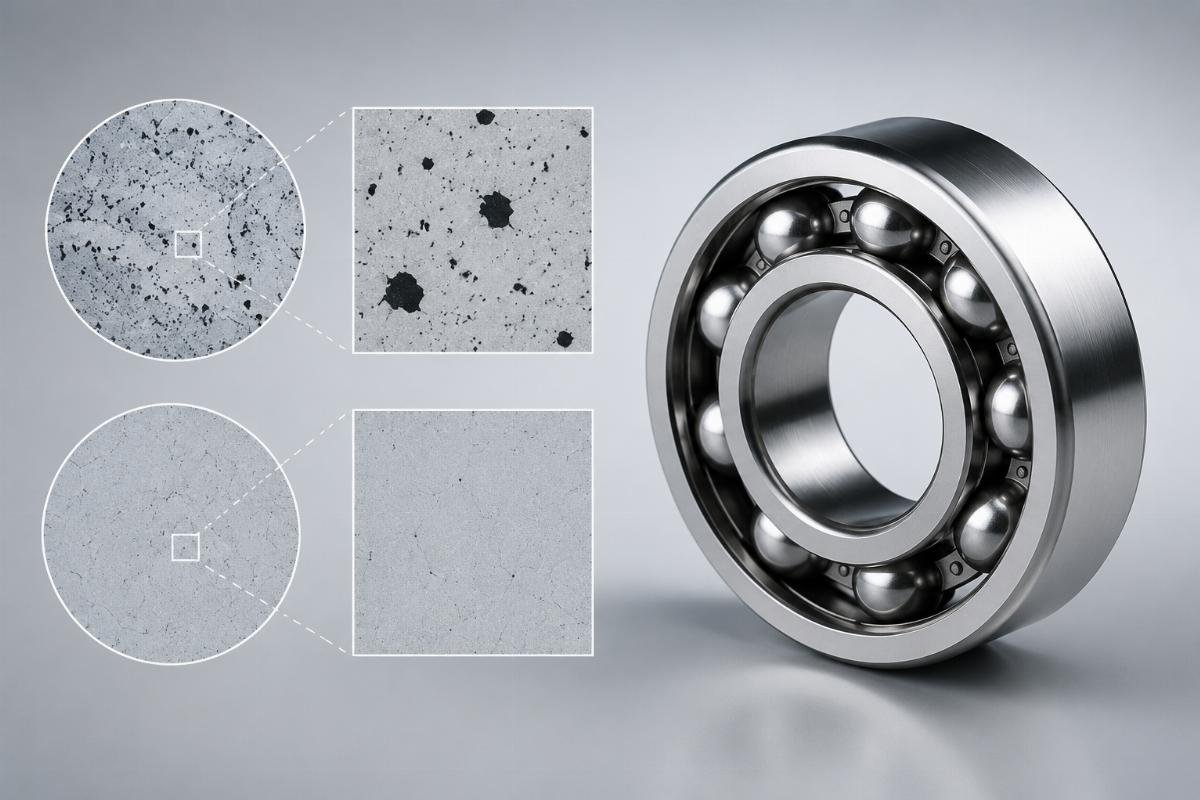
Understanding what truly constitutes high-quality bearing steel and how to verify it can transform your maintenance strategy from reactive to proactive.
Why Does Bearing Steel Grade Selection Impact Equipment Downtime?
Bearing steel grade is the single most critical factor in determining service life. While many maintenance managers focus on dimensions and brand reputation, the chemical composition and processing of the steel itself ultimately dictate performance under load. A bearing with perfect dimensions but substandard steel will fail prematurely, often catastrophically.
| Quality Parameter | Industry Average | Premium Standard |
|---|---|---|
| Hardness Range | Uncontrolled variation | Controlled HRC 58-62 |
| Non-metallic Inclusions | Rating >2.5 | Rating ≤1.5 |
| Material Purity | Standard cleanliness | Substantially higher purity |
| Fatigue Life | Standard L10 rating | Noticeably extended L10 |
| Heat Treatment Uniformity | Inconsistent | Tight control |
Key steel grade parameters include hardness, cleanliness (inclusion content), and microstructure. International standards like DIN 100Cr6, ASTM A295, and JIS SUJ2 define these parameters, but compliance varies significantly among suppliers. Our full inspection system verifies all critical material parameters before shipment, ensuring that each bearing meets the specified grade requirements regardless of external appearance. [NEED_CITE: Relationship between inclusion content and fatigue life per ISO 4967]
We worked with a steel mill experiencing frequent failures of work roll bearings, each causing extended unplanned downtime. Their existing bearings met dimensional specifications but used steel with inconsistent hardness and high inclusion content. After switching to EN 10083-3:2006 certified 100Cr6 steel bearings with substantially higher purity and inclusion rating ≤1.5, they reduced failures dramatically. The spherical roller bearings 22330 CA/W33 with precision grade P6 and C4 clearance not only solved the immediate failure issue but also improved overall equipment efficiency by reducing vibration.
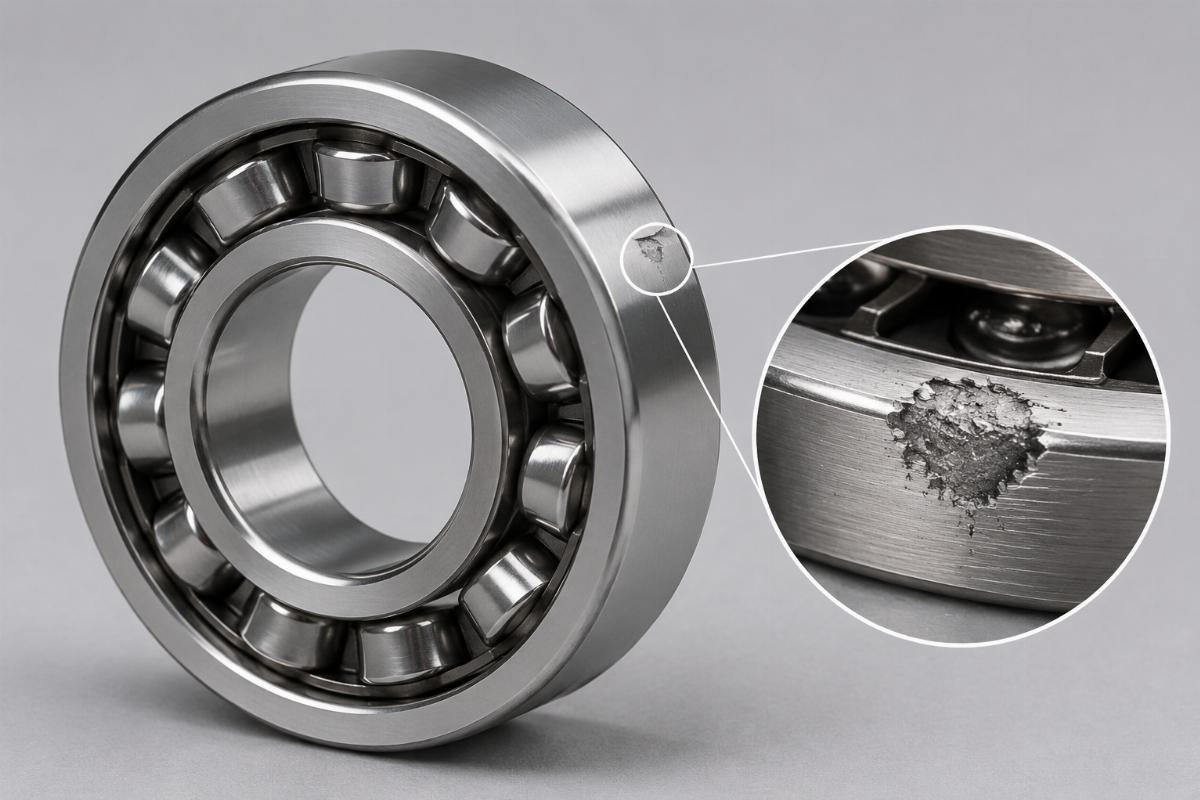
- Hardness Testing – Verify that hardness falls within the optimal HRC 58-62 range using calibrated equipment, not just supplier claims
- Inclusion Rating – Request certification showing inclusion content meets ISO 4967 standards with rating ≤1.5
- Heat Treatment Records – Review documentation confirming uniform temperature distribution during quenching and tempering
- Chemical Analysis – Ensure steel composition matches grade specifications with spectrometric verification
- Microstructure Evaluation – Examine metallographic samples for proper martensite formation and carbide distribution
How Can Buyers Verify Bearing Steel Quality Beyond the Spec Sheet?
Effective bearing steel verification requires both documentation review and supplier capability assessment. Counterfeit bearings often match external dimensions but use recycled steel with inconsistent chemistry, making visual inspection alone insufficient for determining material quality. The consequences of accepting counterfeit bearings extend beyond immediate failure to potential damage to mating components and safety risks. [NEED_CITE: Global economic impact of counterfeit industrial bearings]
| Verification Aspect | Common Mistake | Correct Approach |
|---|---|---|
| Documentation Review | Accepting generic certificates | Requiring batch-specific mill test reports |
| Supplier Assessment | Evaluating based on price alone | Auditing quality control processes |
| Material Verification | Relying on visual inspection | Conducting independent lab analysis |
| Traceability | Ignoring batch tracking | Verifying full production history |
| Certification | Accepting expired certifications | Confirming current ISO/IATF credentials |
Five critical documents ensure material traceability: mill test reports with chemical composition, heat treatment records including time-temperature profiles, non-destructive testing results, metallographic examination reports, and batch traceability logs. Our full traceability capability far exceeds typical industry practices for bearing suppliers, providing complete visibility from raw material to finished product.
A mining company contacted us after a grinding mill bearing failure caused a multi-day production halt. Their previous supplier provided bearings with generic certification that didn’t match the actual product. We expedited emergency replacement tapered roller bearings with full traceability documentation, including spectrometric analysis and heat treatment records. The rapid emergency dispatch prevented further losses, and our subsequent annual contract established a reliable supply chain with predefined quality verification protocols. [NEED_CITE: Importance of batch-level traceability in preventing counterfeit bearing deployment]
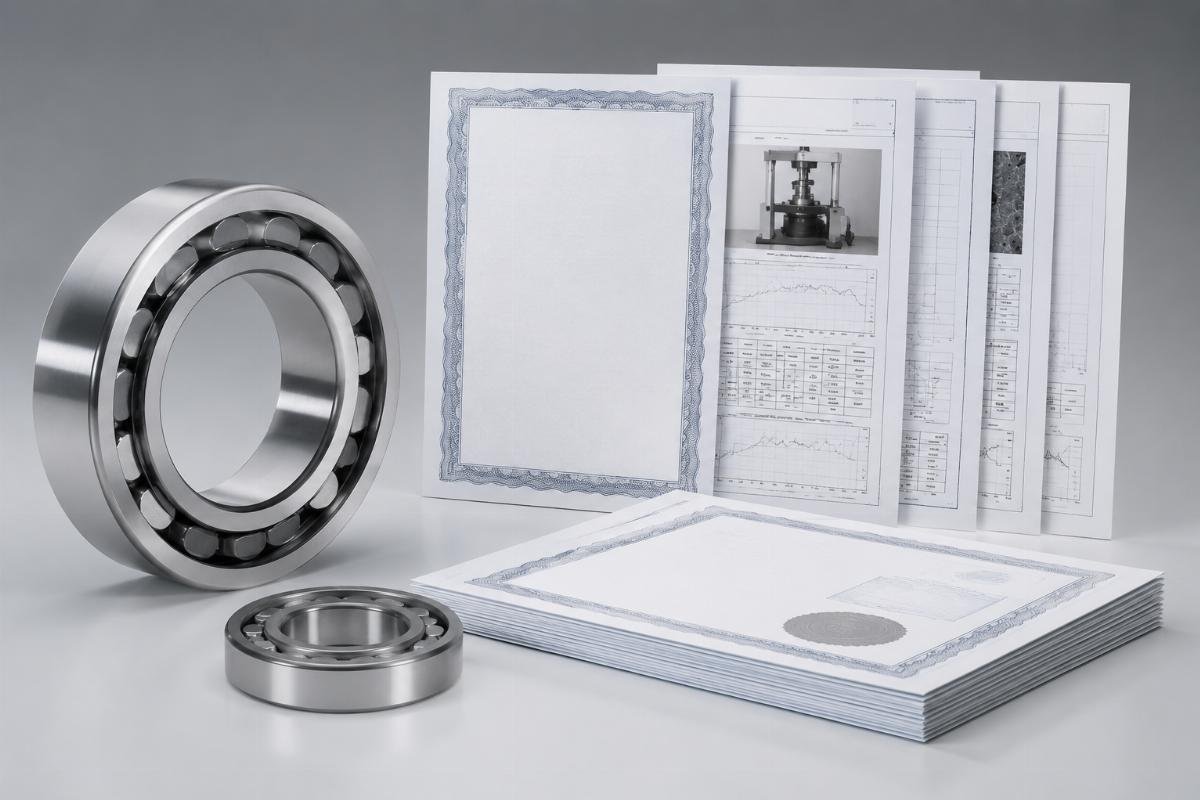
- Mill Test Reports – Verify each batch has unique identification numbers matching physical bearings
- Chemical Analysis – Confirm carbon content and alloying elements meet grade specifications
- Heat Treatment Records – Ensure proper quenching and tempering cycles were followed
- Dimensional Inspection – Cross-check critical tolerances against drawing requirements
- Supplier Quality Manual – Review procedures for raw material incoming inspection
Which Bearing Steel Grades Match Specific Industrial Applications?
There is no one-size-fits-all bearing steel—application-specific factors determine optimal grade selection. The steel that performs best in a wind turbine main shaft will differ significantly from what works in a food processing conveyor, just as mining equipment requires different properties than precision machine tools. Understanding these application-specific requirements is key to maximizing bearing service life. [NEED_CITE: Application-specific bearing steel selection guidelines per ISO 683-17]
| Steel Grade | Performance Advantages | Ideal Applications |
|---|---|---|
| 100Cr6 (Standard) | Balanced hardness and toughness, cost-effective | General industrial machinery, pumps, conveyors |
| 100CrMnSi6-4 (Premium) | Enhanced fatigue resistance, higher impact strength | Mining crushers, grinding mills, heavy-duty gearboxes |
| Stainless Steel (440C) | Corrosion resistance, hygiene properties | Food processing, marine applications, chemical equipment |
| Hybrid Ceramic | Reduced friction, high temperature capability | High-speed spindles, electric vehicle motors, wind turbines |
For mining applications with high shock loads, we recommend premium 100CrMnSi6-4 steel which offers substantially longer service life in conveyor rollers compared to standard grades. Wind energy applications benefit from hybrid ceramic bearings that provide superior fatigue life for extended design requirements, while food processing facilities require stainless steel grades to maintain hygiene standards. Our custom material options include stainless/ceramic/polymer alternatives for specialized applications beyond standard offerings.
One wind energy asset manager needed main shaft bearing qualification for a large turbine fleet, requiring material certification for extended design life. We provided tapered roller bearings 32340 with hybrid ceramic options and precision grade P5, complete with IATF 16949 certification and material test reports including fatigue life L10 rating. The application-specific technical support ensured the bearings met the project’s specialized specification requirements and addressed long lead time concerns through our global warehousing network.
- Load Type – Select higher toughness grades for impact loads; higher hardness for static loads
- Operating Temperature – Choose heat-resistant alloys for temperatures exceeding 120°C
- Environmental Conditions – Specify stainless steel or coatings for corrosive environments
- Speed Requirements – Consider hybrid ceramics for high rotational speeds
- Maintenance Access – Select sealed designs with premium steel for difficult-to-reach applications
How to Secure Reliable Supply with Full Material Traceability?
Partnering with suppliers who control the full material verification process minimizes quality risk. In today’s global supply chain, ensuring consistent quality requires more than just receiving certification documents—it demands verifiable traceability from raw material sourcing through final inspection.
As an authorized SKF bearing distributor, we maintain complete batch traceability on every shipment. Each bearing’s batch number can be verified against SKF’s official registry, eliminating substitution risk. Our deep stock of rare designations—including large bore, special precision/clearance options, ceramic and stainless variants—ships within 48 hours versus typical factory lead times of several weeks.
Every shipment includes certificate of origin and batch traceability documentation. We perform per-batch precision inspection and can arrange third-party inspection on request. For bulk buyers, we offer long-term supply agreements with predefined quality verification protocols.
Our customization capabilities include laser marking, private-label packaging, pre-lubrication, and translated documentation to meet specific project requirements. We accept T/T, L/C, and support DDP/CIF/FOB terms to accommodate diverse procurement preferences.
Technical support includes L10 life calculation and failure analysis assistance, helping maintenance teams make informed decisions about bearing steel grade selection and replacement timing.
Conclusion
Material quality—not just hardness—determines bearing service life. Buyers must verify inclusion content, microstructure, and traceability beyond spec sheets to prevent premature failures. Working with authorized distributors who provide batch-level verification and application-specific technical support transforms maintenance from reactive to proactive, protecting both equipment uptime and operational budgets.
Leave a Reply